TrainsHistoryObservationsHumorAdvertisementsEventsMuseumsPhotosVideosTuesday ToursPost ArchivesHistorical ArtifactsPanorama ProjectRSS FeedFollow us on twitterSubscribe by emailHome

Posts Tagged ‘cornelius vanderbilt’

Friday’s From the Historical Archive: Friday’s Harlem Line History Preview: Quick Facts Train History

Friday, April 23rd, 2010

Here’s a confession: I have difficulty in my perception of the passage of time. Always in History class things felt like they were so far distant. And then when I think about it more, I say to myself, “but there are people still living today that went through those events…” so it isn’t possible that they happened as long ago as my mind thinks. When going through all the stuff I put in the Historical Archive, I decided that I wanted to make a timeline. Timelines are really good, but they generally are limited in scope. They usually deal with a particular subject. I could have easily made a “Harlem Line Timeline.” Would it have made total sense to me though? Probably not. I needed something that sort of puts these events in perspective with other things going on at the time. Knowing Cornelius Vanderbilt was born in 1794 is all dandy. But a timeline gives me more an idea of what is going on when it tells me that the man who had the original Grand Central built was alive when George Washington was alive. Washington is like this massive, legendary figure, that for some reason I imagine lived forever and a day ago. So pretty much, I thought it would be cool to do a comparison timeline, the Harlem Line, and US History. Considering that the Harlem Line was started as a part of one of the older railroads in the country, it sort of makes sense.

And if I was absolutely awesome, I would have that timeline for you right now. But because I’m not quite that awesome, I don’t have it completed. If this was in fact History class I would use this excuse… I don’t frequently talk about my roommates on the blog, but if you think I run into crazy people on the train, you should hear some of the stories of what goes on at my house. Last night I had a headache and my roommates were making a lot of noise. You see, they play in a band. This band practices in the basement. I don’t know what the name of the band is, but at one point in time they have referred to themselves as Vaginal Discharge. I kid you not. To my friends, the lead singer is known as “Stripper Girl,” due to the fact that she once worked at Flashdancers. You know, that Gentleman’s Club that frequently advertises on taxis in the city? Yeah. So with all that noise, I had some difficulties in concentrating, and I figured that my lovely readers would understand.

I figured that I’d give a little preview of what I’m working on though. I promise I’ll finish it soon, along with the historical map I’ve also been working on. Please harass me. I am awesome at starting projects, but terrible at finishing them.


Early history. It will be cooler when finished.


Only 24 states when the New York & Harlem Rail Road was chartered. “That’s like, less than half!” says my roommate. And no, I don’t have pictures of her.

Friday’s From the Historical Archive: “Commodore” Cornelius Vanderbilt History Photos

Friday, March 26th, 2010

This week I figured I would talk about a rather important railroad figure, Cornelius Vanderbilt. He significantly shaped the early history of what are now known as the Hudson and Harlem lines. You may recognize the name, bordering Grand Central Terminal is Vanderbilt Avenue, and even inside the terminal, there is a Vanderbilt Hall. Many Vanderbilts that came after him was known only because of the fortune that Cornelius amassed in first steam boats, and then later, railroads. He wasn’t much of a philanthropist, but in his final years he donated money to what is now known as Vanderbilt University in Tennessee. Apparently many students there have little clue for which Vanderbilt the school was named. This hardly surprises me, as supposedly some children nowadays think that it was Buzz Lightyear, that was the first person to walk on the moon.

Cornelius Vanderbilt, who was nicknamed the Commodore, certainly was an interesting character. In fact, if tabloids as they are now existed when Vanderbilt was alive, they would have loved him. Tiger Woods is absolutely nothing in comparison to Vanderbilt. Cornelius certainly enjoyed his prostitutes. It would be tabloid front page news!

His married life wasn’t much better. Both of his wives were in fact related to him, they were cousins. And even more strange, his first wife, Sophia Johnson, was a cousin on both his mother and his father’s side of the family. It was from one of his prostitutes that Vanderbilt acquired syphilis, which he spread to his wife. Though all of this occurred before penicilin existed. The preferred treatment for syphilis at the time was mercury.

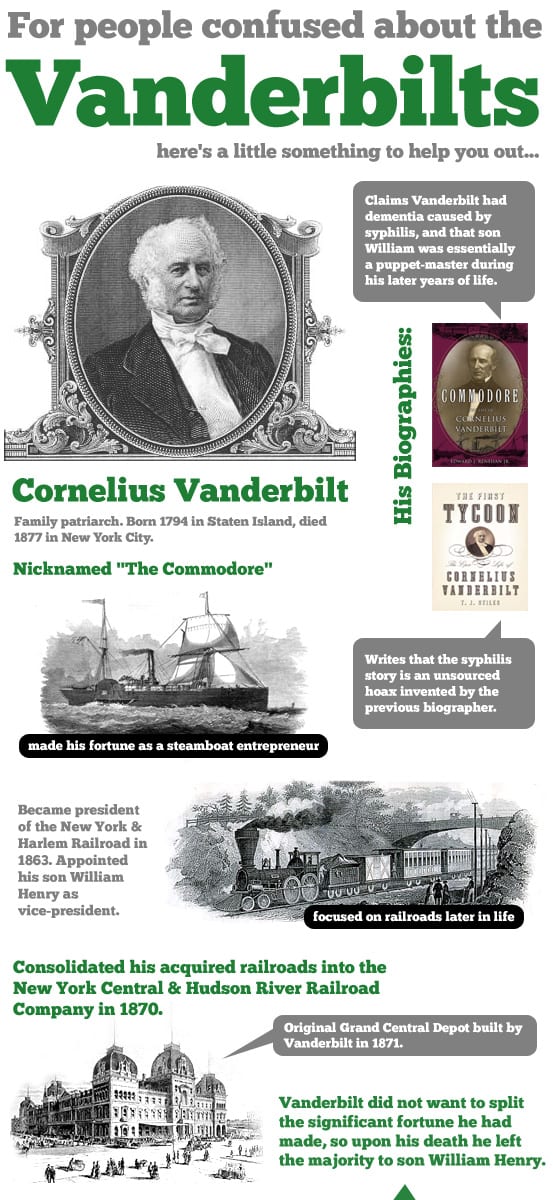
Dementia brought on by late stages of syphilis marked the final years of Vanderbilt’s life. He had built his fortune with small ships, and later steam ships, but it nearly doubled when he got into the railroad business. However it is uncertain how much of this was of his own doing, or the work of his son, Billy. Vanderbilt had eight daughters and three sons. William, known as Billy, was designated as Vanderbilt’s heir. Cornelius hated the idea of his fortune getting split, so upon his death the majority of it was left to Billy. Billy was not his favorite son, however, and was Cornelius’ second choice as heir. George Washington Vanderbilt, Cornelius’ favorite son, died before he was twenty-five from tuberculosis after serving for a time in the Union Army during the Civil War. It was only after his death that Billy became the chosen heir. Vanderbilt’s other son, Cornelius Jeremiah, was essentially disowned. He was explicitly barred from ever referring to himself as Cornelius Vanderbilt, Jr. He was an epileptic, which didn’t win him any favors from his harsh father. But it was his dealings in fraud that truly formed a wedge between himself and his father, who had little desire to pay for his fraudulent son’s debts.

After the death of George Washington Vanderbilt, Cornelius began to groom Billy in his role as heir to the Vanderbilt fortune. He was installed on the boards of various railroads that his father owned or influenced. In his later years Vanderbilt was not completely there due to syphilis’ effect on his brain. However the name Cornelius Vanderbilt instilled confidence to people involved in the industry. So he served much as a figurehead in his later years, with his son Billy making all the decisions. The building of Grand Central Depot was one of such actions.

In his later years, Cornelius married a far younger woman: Frank Crawford. The marriage, however, was mostly one of convenience. Frank was a distant cousin from Alabama who had very little money and ran the risk of becoming completely destitute. Billy on the other hand did not approve of some of the prostitutes that frequently ended up in his father’s bed, and thus desired his father to be married. In fact when Frank arrived as a guest of the Vanderbilts, her mother accompanied her. Vanderbilt’s family didn’t care which of the two he married, the mother or the daughter, but they did want him to marry one. Upon Cornelius’ death his wife received little of the man’s fortune, as Billy had arranged a prenuptial agreement prior to the marriage.

After Cornelius’ death the majority of his fortune was given to Billy, however several of his daughters, and his son Cornelius Jeremiah, contested the will. Their desire to have the fortune split more fairly amongst the Vanderbilt children failed, and not long after Cornelius Jeremiah committed suicide by putting a bullet in his brain.

Although Cornelius is long gone, he is forever in the history books because of the large fortune he amassed, first through ships, and later associated with various railroads such as the New York and Harlem (today’s Harlem Line), the Hudson River Rail Road (today’s Hudson Line) and the entity to which he leased both, the New York Central. In the Historical Archives there are several items regarding Vanderbilt, including several obituaries, and a piece about his life that took up several pages of the New York Times the day after he died.


Vanderbilt’s ego was so immense, he figured that many young ladies, so enamored with him, went to purchase railroad bonds because on each bore his own likeness. The archive also has several railroad bonds on display.

Cornelius still looks out on the city of New York every day. His statue is located under the main facade of Grand Central Terminal.

Please note: This post was written based off of the information in the biography Commodore: The Life of Cornelius Vanderbilt written by Edward J. Renehan Jr. Some of the statements made in the book (including the syphilis and prostitutes) have been questioned by other authors for authenticity.

1877 Newspaper Articles, The Death of Cornelius Vanderbilt Uncategorized

Tuesday, March 23rd, 2010

Articles from various newspapers, published on the 4th and 5th of January, 1877, after the death of Cornelius Vanderbilt.

From the Evening Gazette, in Port Jervis, NY:

From the Titusville Morning Herald:

From the Oshkosh Daily Northwestern:

An article describing the life and death of the Commodore took up several pages of the New York Times the day after his death is available for download here. (35MB File)