
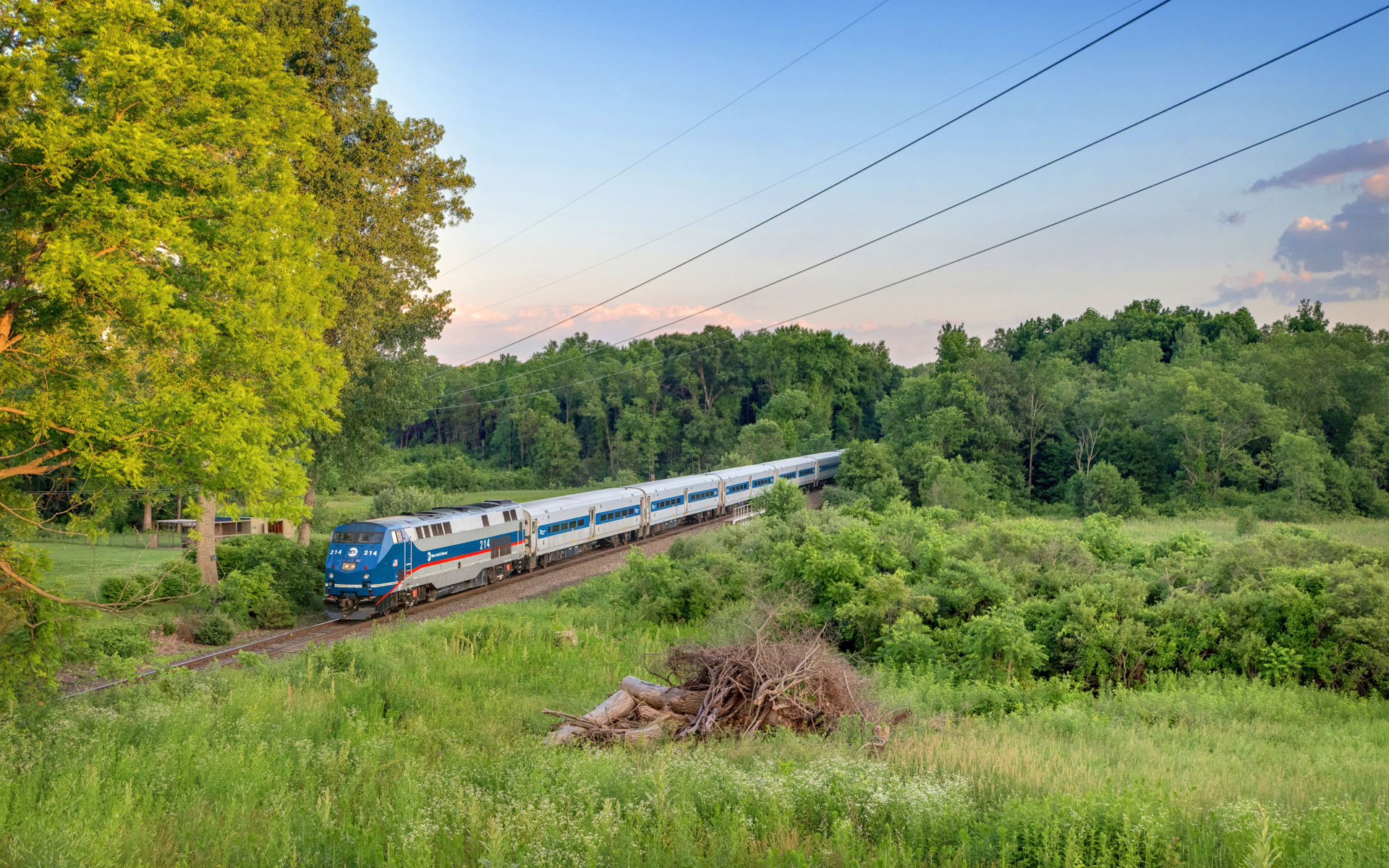
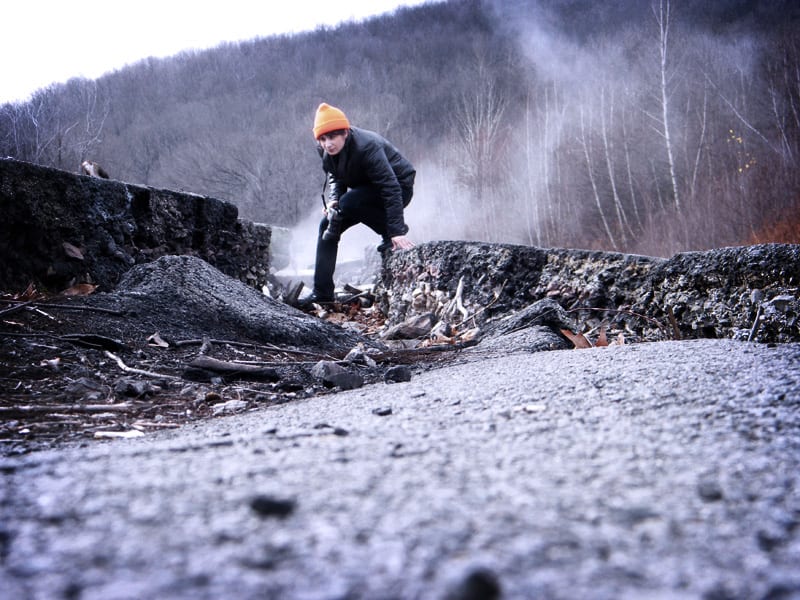
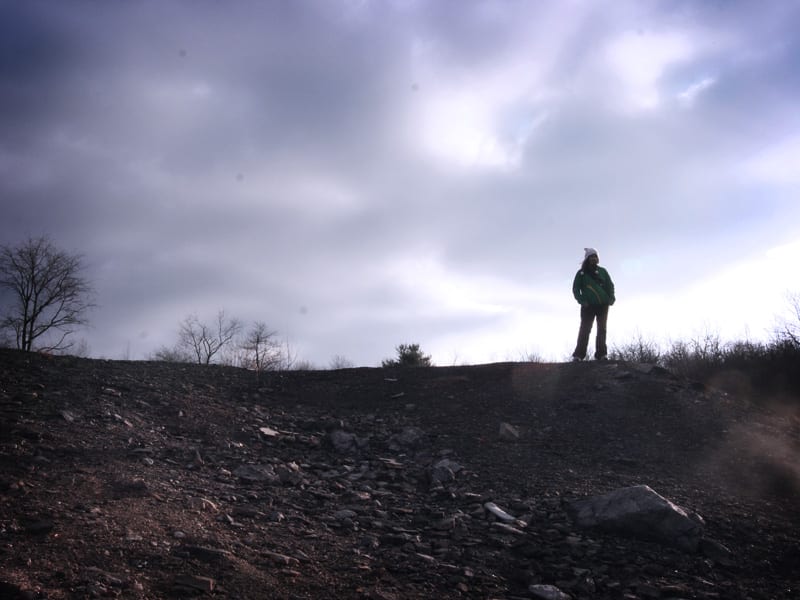
Hopefully you guys aren’t missing me too much… I figured I would set up some posts in the queue to submit themselves while I am gone on vacation, that way you wouldn’t miss me at all. If you haven’t noticed by now, I enjoy going on adventures, and taking photos. On a cool morning last November I boarded an early train to White Plains to meet up with my friend, and partner in crime. From White Plains we drove to a small town in Pennsylvania named Centralia. I first learned about Centralia several years ago, and somehow I became obsessed with its history. Centralia today is nearly a ghost town, with a population of under ten people. In 1981, that population was over 1,000. It was a town full of life, a close-knit community with homes, churches, and shops. But today those homes, churches, and shops are gone… razed long ago. Thin wisps of steam rise from the ground in Centralia, especially so on cool mornings. The ground is warm to the touch, and the air smells of sulfur. Centralia is not like any town you’ve ever encountered, for it is burning, and has been since 1962.
If you’ve ever seen old advertising for the Lackawanna Railroad, you may already be familiar with anthracite. Anthracite is a particular type of coal, which in the United States is found in northwestern Pennsylvania. It burns hotter and cleaner, with less soot, than ordinary coal. In the early 20th century, anthracite was used for a variety of purposes, including home heating, but also to power trains. Although other railroads may have used anthracite, it was the Lackawanna Railroad that made it a part of their advertising. They called their line “The Road of Anthracite” because they chose the more expensive coal to power their locomotives. Anthracite, with its cleaner burn, prevented passengers from the possibility of getting dirty from the soot of a regular coal-burning locomotive. To further underscore this point, the character of Phoebe Snow was created for the advertising. Phoebe was a regular train rider who frequently wore white gowns. Various rhymes using Phoebe were created for advertising:
My gown stays white
From morn till night
Upon the road of Anthracite
Phoebe says
And Phoebe knows
That smoke and cinders
Spoil good clothes
‘Tis thus a pleasure
And Delight
To take the Road
Of Anthracite
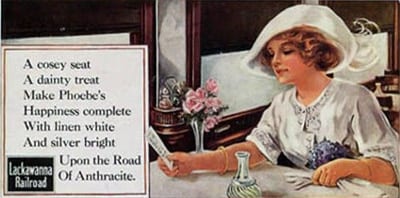
The character, Phoebe Snow, used in Lackawanna Railroad’s advertisements.
During World War One, railroads were not permitted to use anthracite, as it was required for the war effort, so Phoebe’s career essentially ended there. However, in 1949 a passenger train named the Phoebe Snow was debuted on a route from Hoboken to Buffalo, and later from Hoboken to Chicago.
Anthracite figures significantly in the history of Centralia. Centralia was an old anthracite coal-mining town. It is somewhat ironic to note that it was the coal mines that led to the founding of the town, and also the anthracite coal that led to the town’s demise. In 1962 a landfill caught on fire, underneath of which was an old, open strip-mining pit. The fire above ignited a coal seam underground. The actual details of the start of the fire are hazy and frequently argued. One theory believes that the trash in the dump was burned every year, and that particular year the fire was improperly extinguished. Another theory states that a trash hauler threw hot coals from a stove into the dump, causing the fire. Whatever the cause, the coal underneath the town began to burn.
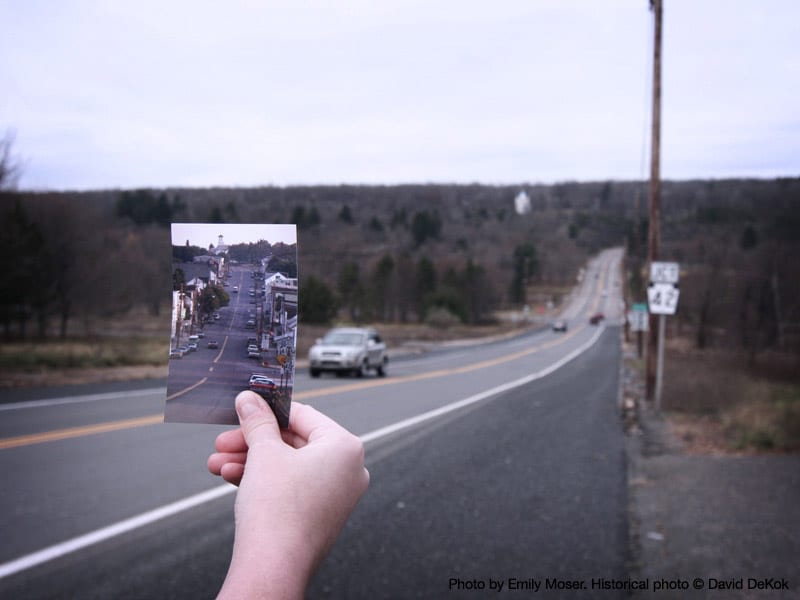
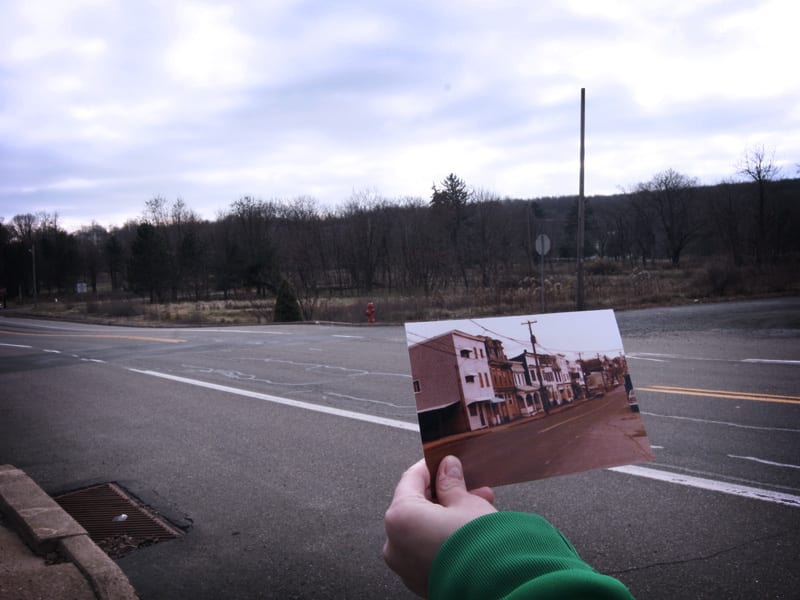
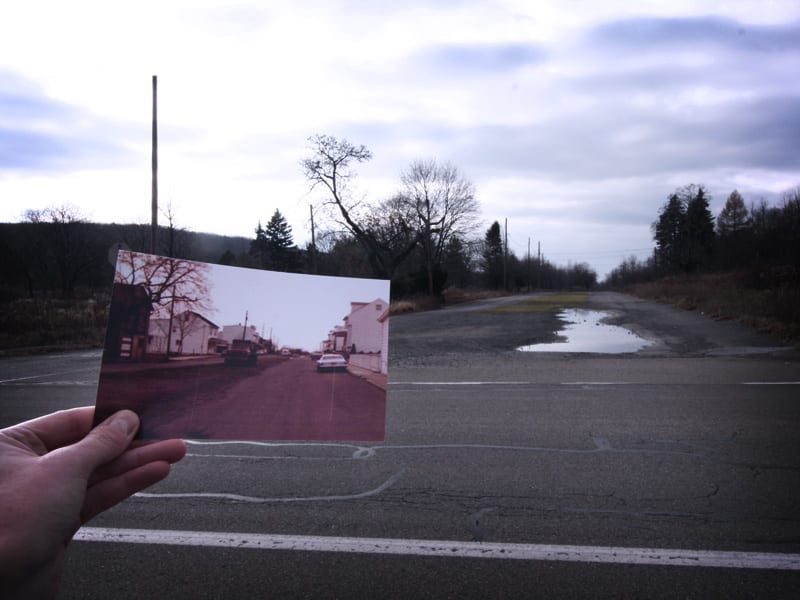
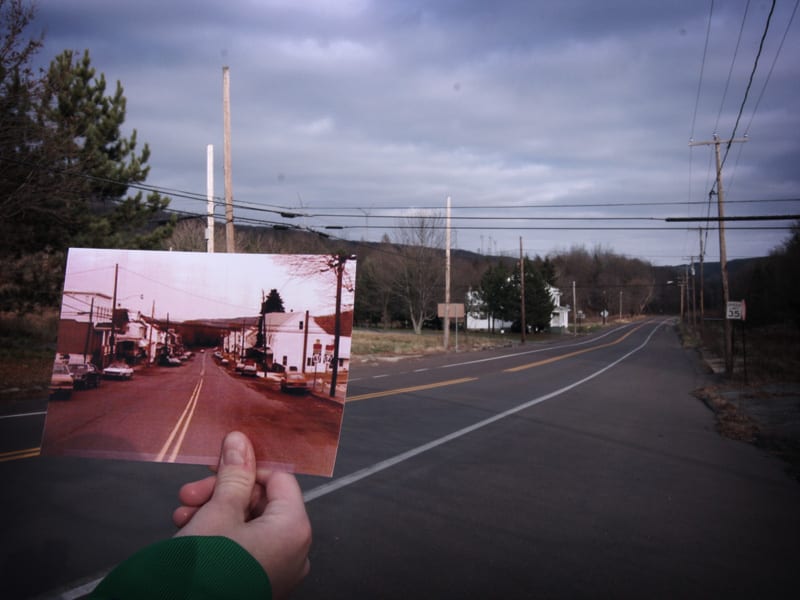
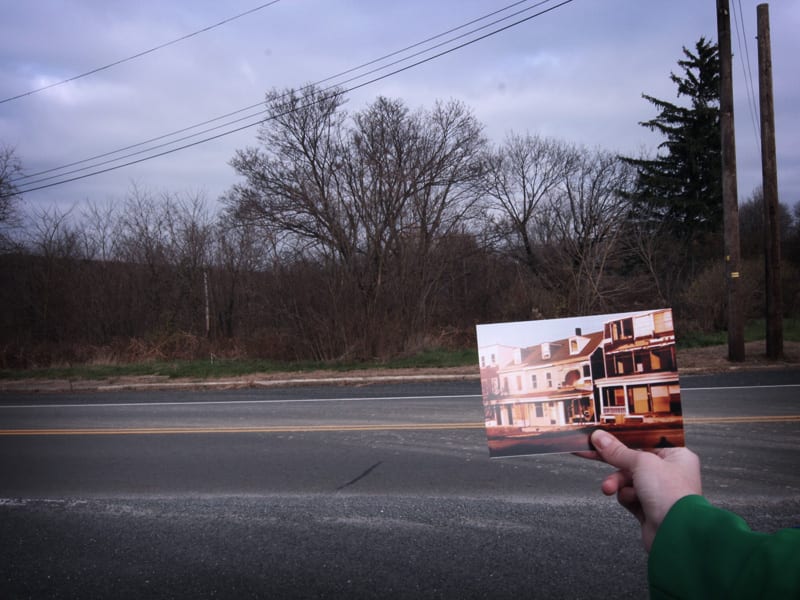
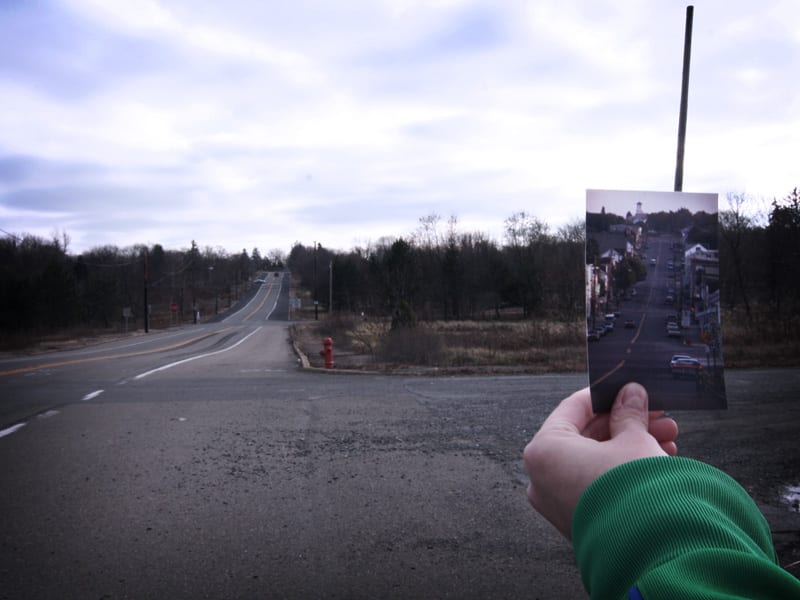
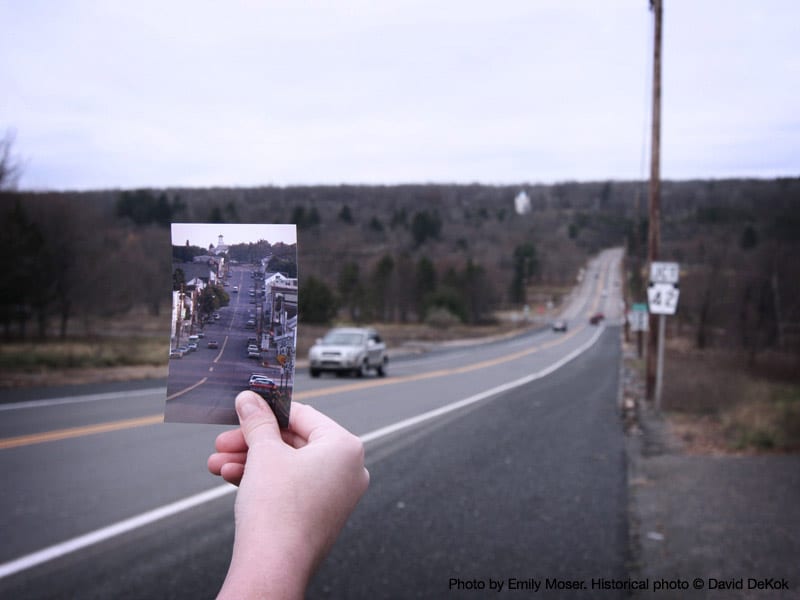
Side by side comparison of Centralia then and now (although this photo was taken from the wrong position, facing the wrong way. However it is my favorite from the adventure). Historical photo © David DeKok.
For the most part, how the fire began is unimportant. It was the hazardous conditions caused by the fire that led to Centralia becoming mostly unlivable. As the fire spread underground, burning along the seams of coal, carbon monoxide and carbon dioxide were released. Efforts to extinguish the fire failed, not because it was impossible, but because of money. It finally came down to the fact that it would be cheaper to relocate everyone in the town than it would be to put out the fire. Centralia was essentially not worth saving, at least in the government’s point of view. In 1984 the government began buying out homeowners in Centralia, allowing them to relocate, and their old houses were demolished. Everyone was told the move was voluntary, no one was going to be forcibly removed. Except of course, that was a lie. In 1992 Pennsylvania clamied eminent domain on all the properties, and condemned all the buildings. The people that refused to give up their town were then essentially squatters in their own homes. The state of Pennsylvania is currently pushing for everyone left in the town to move out. I’m sure they would love to forget the death of a town mostly due to bureaucrats and incompetence… to get everyone out and forget that Centralia ever existed. There are some, however, that will not forget.
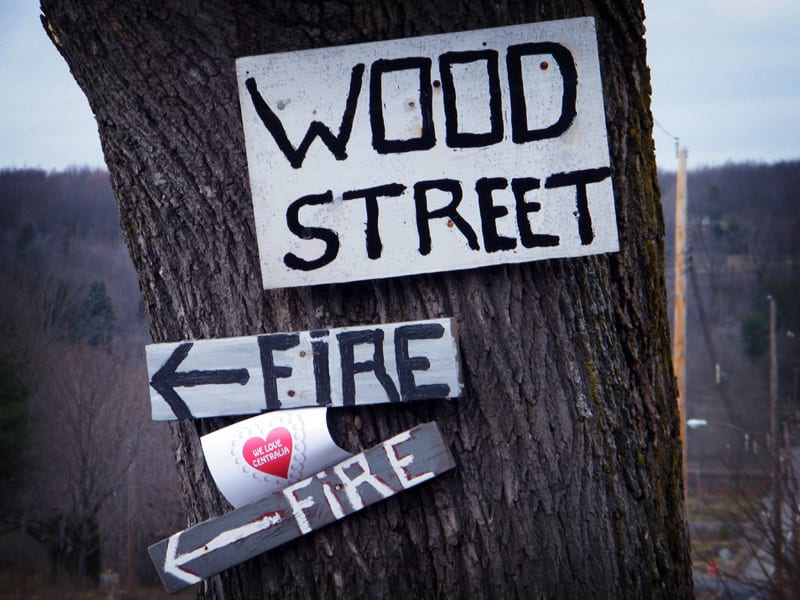
The current mayor of Centralia posted the fire signs above. The We Love Centralia sign was an addition by me.
As it should be, the subject of Centralia is at times a touchy subject. There are a few folks that would deny that the town was ever “unlivable” and that there was ever any danger. I consider this the emotional response to people that didn’t want to see the place that they grew up in, that their families grew up in, destroyed. When Todd Domboski fell into a burning sinkhole, these same people denied that it was a result of the fire. Back then living in the town probably was dangerous. The plumes of steam coming from the hillsides was massive, to the point of dangerously obscuring the roads. However, if you visit Centralia now, the steam is barely there. There seems to be very little danger to the people that are currently living in the town.
The State of Pennsylvania has a long history of mining. Centralia is just the tip of the smoking coal slag heap.
What started as a discovery of some loose black rocks in what would become the Anthracite Coal Region would spawn a transportation network that would allow New York City to expand and become the major metropolitan region it is.
The Delaware and Hudson Canal Company built a canal and inclined plane railway from Honesdale PA to tidewater on the Hudson at Kingston (Roundout) NY. They also imported and ran the first steam engine in the United States, the Stourbridge Lion.
Once the broad gauge Erie Railroad was built, numerous others were quickly built into the region to haul the coal out. Most, also owning the mines that coal was coming out from. The area minted cash for the investors on the backs of the miners.
Once the switch to fuel oil started, the decline began, and the large scale deep mining ended when Knox Coal Company pierced the bottom of the Susquehanna River pretty much flooding most of the active deep mines in the area.
Today the area around Scranton and Wilkes Barre are all over many deep mines, and you can tour one in Scranton. It is WELL worth the trip to give you an idea of what being in a mine was like, the rules the miners worked under to become a “licensed†miner and whole system of mines in PA. Today mining in that area is a cottage industry, with sole miners digging coal out. However, the state still maintains a large Department of mines because they keep the maps to all the holes in the ground.
Once the mining stopped, all of the Anthracite roads went into rapid decline, with the NYO&W failing first in 1957, the Lehigh and New England Railway in 61. The Erie and the Lackawanna merged the Reading, the Lehigh and Hudson River, the Central RR of NJ all being folded into Conrail in 1976. The D&H survived as a bridge road.
You can visit Roebling’s aqueduct crossing of the Delaware in Lackawaxen, it is the oldest suspension bridge in the US with wire cables on the way to the coal mine tour, and of course steam town in Scranton. Scranton is also loaded with lots of churches built by the immigrants who came to mine there and there is a walking tour of those.
Wow! What a cool adventure and crazy story. I am guessing the “Mayor of Centralia” is a self appointed position?
I’m thinking it actually is a position in which the townspeople vote, though of course there are very few of them remaining now. Pretty close to being self-appointed anyways.
Great post as usual!
For one of your adventures you should come over to our side of the river and visit some of the sites mentioned by Steve in his comment, particularly the D&H Canal Museum in High Falls and the Snyder Estate in Rosendale. The latter was the home of cement magnate, Andrew Snyder and features the Widow Jane Mine. Also in Rosendale is the Wallkill Valley Railroad viaduct, at the northern end of the Wallkill Valley Rail Trail.
Not to be missed is the new Walkway Over the Hudson, New York’s newest State Park and the highest pedestrian bridge in the world. Metro North’s Hudson line will take you there (Poughkeepsie).
Thanks for the suggestions! The walkway over the Hudson is a good idea, and isn’t too far away from me. I’m hoping in a few weekends I can get over to the Harlem Valley Rail Trail too. So many photo adventure opportunities :D
Thanks,Emily..You are lucky.Also I am Graphic Designer but not Train rider..
Very cool adventure(Great Pics and Story)!!! I came across the link below and a few google searches later found your story.
Im from Northern California so i wont being thru centralia any time soon, but it is definitely a destination i’d like to see.
http://www.gadling.com/2011/04/27/the-worlds-ten-creepiest-abandoned-cities/
Came across your blog randomly when researching Centralia, PA after hearing this RadioLab podcast titled “Cities.”
http://www.radiolab.org/2010/oct/08/
The last story is about Centralia. Thought you might enjoy.
Cheers!
Oh wow! Nice blog post!! I’d love to visit Centralia! I first learned about it when I was reading about the movie Silent hill and they mentioned Centralia as an inspiration for the setting. Ever since then I’ve been almost obsessed with the town and think about it often and look up as many pictures as I can find of it before and after. It’s such an amazing and interesting place!! Gosh :)) It would be soooo cool to visit it.
Just found your blog thanks to a friend’s Facebook post, so I am catching up. Love this one about your experience in Western PA , and like Steve wrote in April of 2010, I have family history in the Eastern part of PA, the Scranton-Wilkes Barre coal seam. My Dad and his family came from England when the mines there were closing, in the 1920s. They settled in Shickshinny, PA, and my grandfather and his brothers worked the coal mines there. Eventually, my grandfather moved the family to Syracuse, NY when he found work on the railroad. But his brothers and their families stayed in PA. Over the years, we heard nightmare stories about sink holes when the old mine shaft beams were rotting out and collapsing. One aunt’s house was declared unsafe as it was on the edge of a sink hole that eventually claimed it. PA never really acted in the best interests of its residents in these matters, although my guess is there were times when the financial situation within the state was shaky because of the closing of the mines meant reducing tax revenues…just a guess, though. I loved this post as it brought back memories of those tales and tales of the years my grandfathers and great-uncles spent in those holes in the ground! My grandfather had black lung and was blind in one eye from a coal fragment. I cannot imagine what that work was like.