
I Ride the Harlem Line - HomePosts about the trainPosts about observationsHumorous postsPosts about advertisementsPosts about eventsPosts about eventsPosts about museumsPosts with photosPosts with videosPost ArchivesRSS FeedTwitterYouTubePanoramio

Posts Tagged ‘william henry vanderbilt’

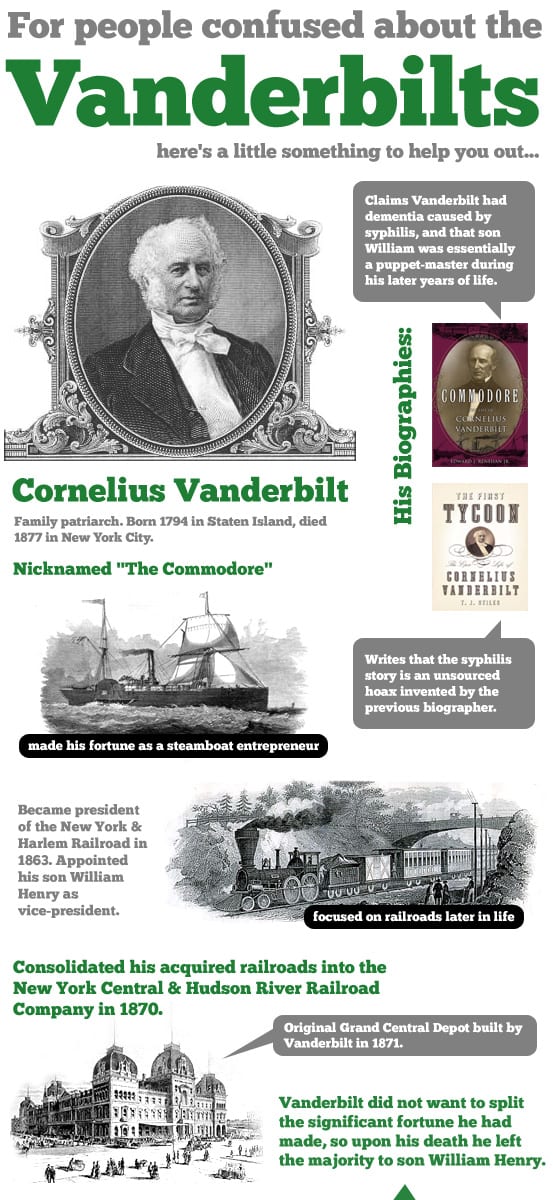
Railroads, Mansions and Money: The Vanderbilts in a nutshell History

Friday, January 14th, 2011

There is a lot of wrong information, or downright confusion, when it comes to the Vanderbilts on the internet. I’ve seen articles saying they earned their fortunes in the 1930′s, and that Gloria Vanderbilt’s father was the man who made the millions. But the family has origins much earlier than that, with the “Commodore Cornelius” Vanderbilt. Can I fault people for the confusion? Not really, considering that there were six or more men named Cornelius, at least five Williams, and several George Washingtons. It is my belief that all New Yorkers, and everyone that ever steps through Grand Central, ought to know about the Commodore and his family that had so much influence on our area. It was he that united New York state’s oldest railroad, with New York city’s oldest railroad. The family that built the New York Central railroad into an empire, and constructed our wonderful monument, Grand Central Terminal. So, if you were ever confused about the Vanderbilts, hopefully they’ll now make more sense to you… as I present to you, the Vanderbilts in a nutshell.


The curious story of the ghost horse in Grand Central History

Friday, October 29th, 2010

For some time I’ve wanted to write a post about a particular odd topic, and have waited until now to do so. I figured Halloween would be an appropriate time of the season to mention it, as not only does it have to do with Grand Central, but a ghost in Grand Central. An equine ghost.

I’m not exactly sure how I first came across the story of racehorse Maud S, but it was likely when randomly reading about some of the Vanderbilts’ extravagant and expensive possessions. Without a doubt, Cornelius Vanderbilt was a true master at making money, and his son William Henry was quite adept at adding to that fortune. Cornelius’s grandchildren on the other hand, William Kissam and Cornelius II, were quite the masters at spending money. Though that is not to say that their father William didn’t purchase some pretty crazy things. One such purchase was the racehorse, Maud S. At the time Maud S was one of the fastest racehorses in the world, and held the record for the fastest mile. Her sale to Vanderbilt infuriated some in the racing world – he was taking this amazing horse away from the races to instead be privately corralled outside of Grand Central so he could ride her whenever it struck his fancy. Of course, this is the 1880′s and much of the area around Grand Central Depot was rural, and in terms of the city of New York, considered well “uptown”. But the fact of the matter was, if one of the richest men in the world wanted one of the fastest horses in the world to pull him around in a carriage, it would be done, and William Henry Vanderbilt certainly had deep enough pockets to pay for it. Plus, he was probably never late to New York Central board meetings.


This entire post was merely an excuse to post a picture of William Vanderbilt’s amazing facial hair

I’m not exactly sure what fascinated me about the story of this horse… maybe the fact that even today, a bed and breakfast has a room named after her? Or maybe how a windmill manufacturing company was also named after her? Perhaps it was her big obituary in the New York Times and other papers across the country? (Several internet sites claim the obituary made the first page of the Times, though this is false – it made the 12th page on March 18, 1900) Nope, I think it was the article in City Scoops that said that she is currently roaming the halls of Grand Central near the Oyster Bar – as a ghost.

Of course, the story is most likely a joke. The author even describes herself as a “professional storyteller”. Whether a joke or not, there are actually tourists that believe this shit! I had no idea that there are actually New York City ghost tours, and ones that even visit Grand Central! Perhaps I am a Halloween party pooper to say it, but there is no ghost of a horse wandering the station. I’d be more likely to believe that ghosts of some commuters haunt the station. In fact maybe that should have been written as a warning in Mileposts – don’t run to your train as you might trip, fall, die, and become the next ghost to wander the halls of the station come next October! And way before Metro North, I’m sure plenty of people have died in the station. It was, after all, built in the early 1900′s, railroading was hardly the safest occupation, plus it was being constructed as the previous station was being dismantled, all while maintaining train service. People certainly have died there. But those deaths are hardly as glamorous, and frankly amusing, as a fancy racehorse.

For all of you that happen to be in Grand Central on Sunday, have a Happy Halloween… and do keep your ears open for suspicious neighing…
…coming from me standing in front of the Oyster Bar.

Friday’s from the historical archive: 1800′s photos from “The Road of the Century” History Photos

Friday, May 7th, 2010

If any of my readers are insomniacs, I highly recommend the book called “The Road of the Century: The Story of the New York Central.” I noticed that one of the libraries in the state owned it, and so I requested my local library to acquire it for me. The copy of the book looks remarkably ancient, though it was only published in 1947. Old enough, I suppose. Upon checking the book out, the librarian said to me, “So… You must like railroads?” I wonder if she were to work at a supermarket, and a customer was to purchase toilet paper, would she ask, “So… You must like toilet paper?” or “So… You must enjoy going to the bathroom?” …Sorry, I went off on a little tangent there. Back to the book, this dreadful, awful book. I don’t think I’ve ever held in my hand a more boring book… hence my comment about insomniacs. Get a copy, it will put you right to sleep. The New York Central has quite a rich history, but no one could have told it in a more dry fashion. In my mind I hear Ben Stein reciting the words in complete monotone…

So why exactly would I bore my readers with stories of a horrible book? Because it had one redeeming quality. Pictures. Wow, don’t I feel like a child, saying the only good part of a book was the pictures. But the pictures, they were good, and I figured I’d share with you all. Let’s “read” this book, together. And when I say read, I mean look at the pictures, and ignore all the snooze-inducing text.


Apparently the book was a donation to the library from the New York Central itself


1864, Michigan Southern & Northern Indiana conductors (or perhaps Abraham Lincoln impersonators).


1877, Train with snow plow during a snow storm.


1896, First advertisement of Red Cap service.

See more pictures from the atrocious book “The Road of the Century”

Friday’s From the Historical Archive: “Commodore” Cornelius Vanderbilt History Photos

Friday, March 26th, 2010

This week I figured I would talk about a rather important railroad figure, Cornelius Vanderbilt. He significantly shaped the early history of what are now known as the Hudson and Harlem lines. You may recognize the name, bordering Grand Central Terminal is Vanderbilt Avenue, and even inside the terminal, there is a Vanderbilt Hall. Many Vanderbilts that came after him was known only because of the fortune that Cornelius amassed in first steam boats, and then later, railroads. He wasn’t much of a philanthropist, but in his final years he donated money to what is now known as Vanderbilt University in Tennessee. Apparently many students there have little clue for which Vanderbilt the school was named. This hardly surprises me, as supposedly some children nowadays think that it was Buzz Lightyear, that was the first person to walk on the moon.

Cornelius Vanderbilt, who was nicknamed the Commodore, certainly was an interesting character. In fact, if tabloids as they are now existed when Vanderbilt was alive, they would have loved him. Tiger Woods is absolutely nothing in comparison to Vanderbilt. Cornelius certainly enjoyed his prostitutes. It would be tabloid front page news!

His married life wasn’t much better. Both of his wives were in fact related to him, they were cousins. And even more strange, his first wife, Sophia Johnson, was a cousin on both his mother and his father’s side of the family. It was from one of his prostitutes that Vanderbilt acquired syphilis, which he spread to his wife. Though all of this occurred before penicilin existed. The preferred treatment for syphilis at the time was mercury.

Dementia brought on by late stages of syphilis marked the final years of Vanderbilt’s life. He had built his fortune with small ships, and later steam ships, but it nearly doubled when he got into the railroad business. However it is uncertain how much of this was of his own doing, or the work of his son, Billy. Vanderbilt had eight daughters and three sons. William, known as Billy, was designated as Vanderbilt’s heir. Cornelius hated the idea of his fortune getting split, so upon his death the majority of it was left to Billy. Billy was not his favorite son, however, and was Cornelius’ second choice as heir. George Washington Vanderbilt, Cornelius’ favorite son, died before he was twenty-five from tuberculosis after serving for a time in the Union Army during the Civil War. It was only after his death that Billy became the chosen heir. Vanderbilt’s other son, Cornelius Jeremiah, was essentially disowned. He was explicitly barred from ever referring to himself as Cornelius Vanderbilt, Jr. He was an epileptic, which didn’t win him any favors from his harsh father. But it was his dealings in fraud that truly formed a wedge between himself and his father, who had little desire to pay for his fraudulent son’s debts.

After the death of George Washington Vanderbilt, Cornelius began to groom Billy in his role as heir to the Vanderbilt fortune. He was installed on the boards of various railroads that his father owned or influenced. In his later years Vanderbilt was not completely there due to syphilis’ effect on his brain. However the name Cornelius Vanderbilt instilled confidence to people involved in the industry. So he served much as a figurehead in his later years, with his son Billy making all the decisions. The building of Grand Central Depot was one of such actions.

In his later years, Cornelius married a far younger woman: Frank Crawford. The marriage, however, was mostly one of convenience. Frank was a distant cousin from Alabama who had very little money and ran the risk of becoming completely destitute. Billy on the other hand did not approve of some of the prostitutes that frequently ended up in his father’s bed, and thus desired his father to be married. In fact when Frank arrived as a guest of the Vanderbilts, her mother accompanied her. Vanderbilt’s family didn’t care which of the two he married, the mother or the daughter, but they did want him to marry one. Upon Cornelius’ death his wife received little of the man’s fortune, as Billy had arranged a prenuptial agreement prior to the marriage.

After Cornelius’ death the majority of his fortune was given to Billy, however several of his daughters, and his son Cornelius Jeremiah, contested the will. Their desire to have the fortune split more fairly amongst the Vanderbilt children failed, and not long after Cornelius Jeremiah committed suicide by putting a bullet in his brain.

Although Cornelius is long gone, he is forever in the history books because of the large fortune he amassed, first through ships, and later associated with various railroads such as the New York and Harlem (today’s Harlem Line), the Hudson River Rail Road (today’s Hudson Line) and the entity to which he leased both, the New York Central. In the Historical Archives there are several items regarding Vanderbilt, including several obituaries, and a piece about his life that took up several pages of the New York Times the day after he died.


Vanderbilt’s ego was so immense, he figured that many young ladies, so enamored with him, went to purchase railroad bonds because on each bore his own likeness. The archive also has several railroad bonds on display.

Cornelius still looks out on the city of New York every day. His statue is located under the main facade of Grand Central Terminal.

Please note: This post was written based off of the information in the biography Commodore: The Life of Cornelius Vanderbilt written by Edward J. Renehan Jr. Some of the statements made in the book (including the syphilis and prostitutes) have been questioned by other authors for authenticity.