I Ride the Harlem Line - HomePosts about the trainPosts about observationsHumorous postsPosts about advertisementsPosts about eventsPosts about eventsPosts about museumsPosts with photosPosts with videosPost ArchivesRSS FeedTwitterYouTubePanoramio

Posts Tagged ‘railroad bridge’

Tuesday Tour of the New Haven Line: Riverside Train Photos

Tuesday, January 31st, 2012


Riverside station in 1954

In-between the stations of Cos Cob and Old Greenwich on the New Haven main line, lies the station of Riverside. A journey to Grand Central, approximately 30 miles, takes around an hour. Four tracks run through Riverside, and two platforms run alongside the two outer tracks. On those platforms you can find a few ticket vending machines, a soda machine, a couple newspaper boxes, and a bench or two. One side has a small shelter from the elements, though it looks pretty beat-up and is tagged with graffiti and strewn with trash.

Riverside station itself is not particularly noteworthy – though the bridge that carries traffic over the tracks is one of Connecticut’s historic bridges – and a little bit more interesting.


Aerial photographs of Riverside and the bridge in 1977


Various sketches of truss bridges, from the patents of bridge engineer Francis Lowthrop

The historic Riverside Avenue bridge is clearly visible to anyone taking the train from or past Riverside station. Not only does it carry traffic over the four railroad tracks, it has two stairwells and an area for pedestrians to cross over to the other side of the platform. Although this bridge was originally constructed in 1871, it did not find its current home until around 1894. Designed by Francis Lowthrop and fabricated by the Keystone Bridge Company, the current span was a portion of a larger railroad bridge over the Housatonic River in Stratford. That bridge was replaced in 1884.


Photos of Riverside and the bridge in 1984

The portion of the Riverside Avenue Bridge that was reconstructed here is smaller than original – the bridge is now 164 feet long and 22 feet wide, and about 20 feet above the tracks. Bridges similar to this one are very rare today, and the Riverside Avenue bridge is the last cast-iron bridge still in use in Connecticut. With the increasing weight of heavy locomotives, many cast-iron bridges were simply replaced due to safety issues, or modified to carry lighter cars instead of trains, which explains their rarity today. By 1986 the safety of this bridge was also being questioned, and parts were deemed unsafe. However, instead of replacing the bridge or restricting it to only pedestrians, a new bridge was built inside the historical bridge. This solution allowed the preservation of the historic bridge without compromising the safety of the drivers that cross it every day.

The Riverside Avenue bridge was added to the National Register of Historic Places in 1977, and is one of roughly 55 bridges on the Register from Connecticut. It is also the oldest railroad bridge listed in Connecticut (though it only carried trains for a short period of its lifetime).


The branches of the New Haven Line, in pictures Train Photos

Wednesday, December 28th, 2011

Yesterday I featured the only outstanding New Haven Line branch station on our Tuesday Tour, Springdale. Now that the branches are complete, I thought it might be nice to post one of my favorite images from each station in a single gallery. It gives you a quick idea of what each branch is like, and a glimpse into the life of a commuter from each station. The locales photographed vary from outstanding examples of historical stations and well-known landmarks, to bare-bones, concrete platforms that are just barely stations. Each branch terminates at a historically-important station, though only one of the three is being used in its original capacity as a passenger station.

The photographs below were taken on eight separate days, ranging from early March to mid-October.

The New Canaan Branch:

The New Canaan branch is the shortest of the three (8.2 miles), and the closest to Grand Central. It is also the only branch that is currently electrified. The branch first came into being when chartered as the New Canaan Railroad in 1866. By 1890 it had become a part of the The New York, New Haven and Hartford Railroad.

The awesome: New Canaan station may be the nicest station of all three branches (one could argue that Waterbury is more iconic, however it is no longer in use by the railroad, whereas New Canaan is).
Most underwhelming: Everything other than New Canaan.


The Danbury Branch:

Of the three New Haven Line branches, the Danbury Branch has the most stations, with a total of seven. Though the line continues further north, Metro-North service terminates at Danbury. The original Danbury station still exists, though it is not used by Metro-North. Service first began here in 1852, and the rail line was known as the Danbury and Norwalk Railroad. In the late 1800′s the line was leased to the Housatonic Railroad, and later the New York, New Haven and Hartford Railroad. By 1925 the track was electrified, but due to a poor economic situation, it was de-electrified in 1961.

The awesome: Danbury’s original station, yard, and turntable, now occupied the Danbury Railway Museum. Bethel’s old station is now a bike shop (I never got a photo of it). Cannondale’s old station is also lovely.
Most underwhelming: Without a doubt, Merritt 7. It is the only New Haven Line station without the typical Metro-North station sign, and is probably the most bare-bones station listed here.


The Waterbury Branch:

The Waterbury branch is Metro-North’s easternmost branch, and it diverges from the main line just east of Stratford. Although service terminates in Waterbury, the tracks do continue further north, and are used by the Railroad Museum of New England. Waterbury is located 87.5 miles from Grand Central – making it the furthest from the city in rail miles. The branch was originally chartered in 1845 as the Naugatuck Railroad (named after the river the tracks run alongside), and construction was completed by 1849. It was merged with the The New York, New Haven and Hartford Railroad in 1906. Today, the branch has a reputation of serving both commuters and many sketchy people.

The awesome: Waterbury’s historical station (no longer used by the railroad) is one of, if not the most iconic structures in the city. The Naugatuck Historical Society is housed in their old station, which is also nice. You can get cool photos of the railroad bridge in Ansonia.
Most underwhelming: Beacon Falls and Ansonia. Oh, and don’t leave your car or any other valuables at Waterbury.


Do you have a favorite?

If I had to pick the branch that I liked the best, I’d have a difficult time of it. New Canaan is certainly my favorite station, but the rest of the branch is relatively boring. The Danbury branch has the adorably-cute Cannondale, and the old station which is now a museum. The sketchy people of the Waterbury branch make me weary of choosing it as my favorite, despite the fact that I like that little railroad bridge over the Naugatuck river. It is, however, undeniable that Waterbury has the most recognizable old station – though it is debatable whether people actually realize it was once a train station. We can settle this right now, with a poll. Vote for your favorite branch here:

Which New Haven Line branch do you like best?

View Results

Loading ... Loading ...

Tuesday Tour of the New Haven Line: Ansonia Train Photos

Tuesday, June 7th, 2011

On Saturday my family had a surprise birthday party for my father, and I was the one tasked with getting him out of the house while everybody assembled at my parents’ house. Due to the fact that I don’t drive, this was somewhat easy – I just had to get him to give me a ride somewhere. Somehow, I convinced him to go over to Ansonia station so I could take photos, and then to pick up some tools to work on my railroad sign/lights. I punched in the address for Ansonia in the GPS, and when we arrived my Dad was like, “So, where’s the station?” I pointed and said that it was right in front of us. He was confused, “No really, where is it?”

Needless to say, the Ansonia station is very small. I almost don’t even want to call it a station, it is a railroad stop. There is a track, a small low-level platform, a canopy and bus-stop style waiting area, and that is about it. Well, actually there were crows that were probably feasting on something a train had run over, and stacks of Watchtower magazines left by the delightful Jehovah’s Witnesses (people with propaganda love train stations!). On the 71 mile ride to Grand Central, you’ll have plenty of time to read that aforementioned propaganda – especially since there are no direct to Grand Central trains on the Waterbury Branch. Slightly more interesting than the station was the railroad bridge just south of the station, where the tracks cross the Naugatuck River. I waited for the late north-bound train, and didn’t even get that spectacular of a photo.


Fall Photos from the Walkway Over the Hudson History Photos

Thursday, December 16th, 2010

Several of my blog readers have been long convincing me that I needed to get over and see the Walkway Over the Hudson. At the end of October I cheated on the Harlem, and hung out over on the Hudson side of things – checking out the former station in LaGrange, Bannerman Castle, Milton-on-Hudson’s historic station (pictures yet to be posted), and the Walkway Over the Hudson. Other than the fact that I was pretty sick that day, the trip was great. The day was beautiful and warm. And considering I felt like crap and had to cough up a few hairballs (the perfect euphemism for me!) after taking these photos, I’m pretty proud that I managed to get some good ones.


Old postcard views of the bridge

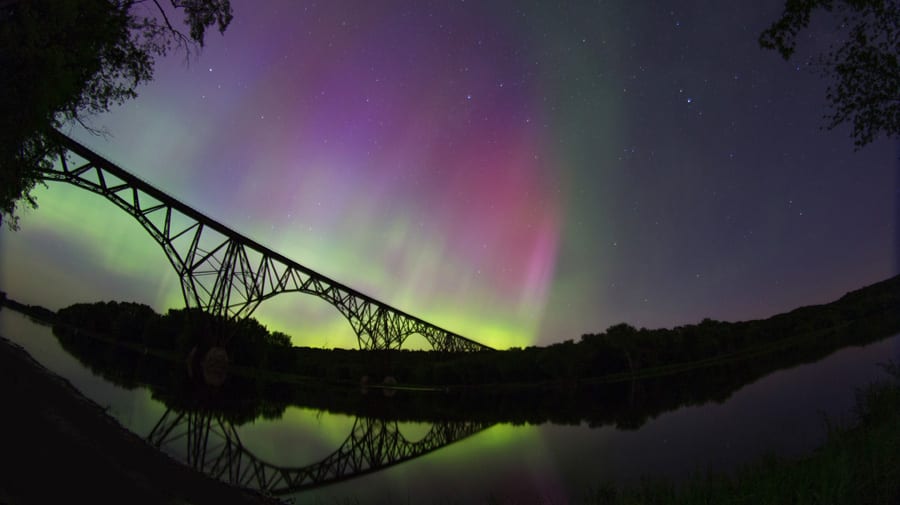
Of course the Walkway has only been a walkway for a relatively short amount of time. The majority of its years were spent carrying trains over the Hudson River. The Poughkeepsie-Highland Railroad Bridge, completed in 1888, was a modern wonder – and one of the longest bridges in the world at the time. The bridge served as an important crossing, especially for troops during World War II. It is estimated that 3,500 train cars passed over the bridge every day during that period. After the 60′s the bridge’s importance declined, and it was damaged by fire in the 70′s. By the 90′s Walkway Over the Hudson proposed turning it into a pedestrian bridge, and in 1998 the bridge was deeded to them. Construction began in 2008, and was completed in 2009. The Walkway Over the Hudson State Historical Park was officially opened on October 3, 2009. It is accessible from both sides of the river in Poughkeepsie and Highland. It is also accessible from Metro-North’s Poughkeepsie station. The walkway offers gorgeous views of the Hudson River, the Mid-Hudson Bridge, and Highland and Poughkeepsie. It also connects with the Hudson Valley Rail Trail in Highland. A few of the photos below, such as the one of the caboose, is from that rail trail.


History of my Hometown: The Railroad in Southbury Train History Photos

Friday, December 3rd, 2010

Despite the fact that I’ve been a Harlem Line rider for most of my life, I didn’t actually live in New York until two years ago (sorry regular readers, I’ve probably said that a million times). I grew up in a small farm town in Connecticut called Southbury. The place would be miserably boring, except for the fact that Interstate 84 bisects the town, making it easier to get to the more populated areas of Waterbury and Danbury. Southbury is just about equally distant from those two, with Danbury to the west and Waterbury to the east. But Danbury and Waterbury branch trains were hardly as frequent and reliable as those on the Harlem Line, so we always took a ride to either Brewster or Southeast and boarded the train from there.

Southbury isn’t much of a farmtown anymore, however. Many of the farms have been sold for commercial purposes. The place where I used to pick pumpkins as a child is now a strip mall, complete with grocery and office supply stores. A once-grassy hill is now home to a chain pharmacy. After the place had been constructed, a few finishing details were added to the outside of the building: one of which was the address. 14 Depot Hill. Apparently the construction workers were hardly typographers, and didn’t place the ‘p’ on the proper baseline, making it look like ‘DePot.’ It prompted an editorial in the local newspaper, reminding the town of why exactly the road was called Depot Hill – it was once the location of a long-gone railroad depot.

I had known there was a railroad past in the town. In school it was briefly discussed – including the head-on collision between two trains that supposedly was the end of the railroad. After reading much on the subject of rail history, I seriously doubted this. Railroading wasn’t the safest occupation, and accidents happened frequently. I hardly believed an accident would cause the line to be shut down. But on December 10, 1892 two trains did collide – and the engineer and conductor on one were thrown in jail for apparently forgetting they were scheduled to wait on a siding for an oncoming train to pass. It didn’t mark the end of the rail line, though.


Southbury’s station was part of the New York and New England Railroad, which operated from 1849 to 1898. In 1898 the New York, New Haven and Hartford Railroad leased the line. Service to Southbury continued until 1948. Today there is hardly any evidence that a railroad ran through the town, except for Depot Hill, and a few remaining portions of the railroad trestle bridge that spanned Lake Zoar. Some of the former rail bed has been converted into the Larkin State Bridle Trail. Below are some photos of the railroad around my old town that I found in a few books and such. Most of them aren’t the best quality.


I am not 100% sure that the railroad bridge shown in the last historical picture corresponds with the remaining trestles that are there today (two bottom photos). The geography doesn’t quite match… though it is possible that the photo was taken before the Stevenson Dam was erected, which presumably altered that area, creating Lake Zoar. If anybody knows more about this, or actually has a photo that is definitely of that railroad bridge, leave me a comment!

Nature along the Harlem Line: The Muscoot Reservoir & Bridge L-158 Photos

Friday, September 17th, 2010

I thought it might be fun to do something different this Friday… Tuesdays I visit train stations, but I don’t talk much about what else is around the station. The Harlem Line has plenty of intriguing spots along the route, and many for the nature lover. I do get emails every once and a while asking me questions about doing things – people wondering what is within walking distance of the stations, and what they can get away and do. And for those who, like me, do not drive, or don’t feel like driving, you can definitely take Metro-North to get to interesting spots.

As I mentioned, there are many nature-related locales on the Harlem Line. Some of the obvious ones are the Botanical Garden and the Appalachian Trail, but there are many lesser-known spots. Pawling has the Pawling Nature Reserve, which is not far from the Appalachian Trail. At the end of the line in Wassaic is the trailhead for the Harlem Valley Rail Trail which follows the old route the Harlem Line once took further north. Lower Westchester has the Bronx River Parkway Reservation which is more than 13 miles long and stretches from Valhalla to Bronxville – and passes by North White Plains, White Plains, Hartsdale, Scarsdale, Crestwood and Tuckahoe stations.

One of the lesser-known spots is near and dear to my heart, situated in Goldens Bridge and not far from my house. In the evenings it is here that I make laughable attempts at running off the past nine years I spent sitting on my ass in front of a computer. In all seriousness though, it is beautiful and quiet little spot that few people other than fisherman and neighborhood residents (and some deer, swans and bullfrogs) know about. The trails are not extensive, but they surround the beautiful reservoir and provide access to various fishing spots. I went one step beyond that and purchased a boat for use on the reservoir as well (boat use is heavily regulated, this is NYC’s drinking water, after all). However, the most noteworthy part of this “Public Access” DEP area is the old railroad bridge.


I created this map based on my own explorations of the area. Maps are actually fun to make. :P

I’ve mentioned Bridge L-158 a few times before. It is one of the few remaining vestiges of the branch of the Harlem Line that ran from Goldens Bridge to Lake Mahopac, and is on the National Register of Historic Places. It was originally built in 1883 over Rondout Creek near Kingston, NY, but was moved in 1904 by the New York Central Railroad to Goldens Bridge. Although the original bridge carried two tracks, the Mahopac branch was a single track line and when the bridge was reconstructed the width was shortened for a single track.


If you’re interested in visiting this part of the Harlem Line, it is within walking distance of Goldens Bridge station. Although it is rarely enforced, you do need an access permit to use the land for recreational use. But access permits are easy to get – you can register for one online and print it out immediately. If you’re interested in fishing or boating, you’ll need additional permits, so I advise checking the DEP’s site. People fish in the reservoir all year long, as the Muscoot is one of the reservoirs in which ice fishing is permitted. Although it is a lot smaller than some of the other nature spots around it is at least worth visiting to see the historic bridge. There are some times where it gets so quiet, except for the crunching leaves under the foot of a squirrel or deer, that you forget that you’re not that far from the city… only until you hear a train go by, yanking you back to reality.

Snow Over Railroad Bridge L-158 Train Photos

Wednesday, February 10th, 2010

A thick blanket of snow has covered New York today, a snow some media dramaqueens have called a “snowpocalypse”. I must admit I laugh every time I hear that term. While some folks were collectively crapping their pants due to snow, I instead decided to take a walk (after sleeping late of course, work was cancelled after all). Not far from my house (and from Goldens Bridge station) is an old railroad bridge with a lonely numerical designation: L-158. With the area covered in snow, it looked even more lonely.

[singlepic id=517 w=600 h=450 float=none] 2 3 4
Additional photos of L-158 can be found in the image gallery.

L-158 was once a railroad bridge, though the tracks are long gone. It was originally built in 1883 over Rondout Creek near Kingston, NY. In 1904 it was dismantled and reconstructed in Goldens Bridge to cover the expanding reservoir. The tracks were part of the Lake Mahopac Branch, which opened in 1872, and went from Goldens Bridge to Lake Mahopac. The Lake Mahopac Branch ended service in 1959, and the tracks were removed soon after. In 1978 L-158 was listed on the National Register of Historic Places.


All historical information and photographs come from Louis Grogan’s book The Coming of the New York and Harlem Railroad. Years for the photos above are as follows: 1951, 1948 and 1946

Ever since I moved to Goldens Bridge, I’ve always been fascinated by this bridge. It is situated on land owned by the DEP, and thus you must have a Watershed Access Pass in order to visit. I have a rowboat on the Muscoot Reservoir, and many summer days I went out on the water rowing underneath the bridge. And as witnessed by the photo gallery, took way too many pictures of the bridge. I’m really longing for the return of the spring and summer so I can go out and row again, and to see L-158 surrounded by greenery, as opposed to today’s snowfall.