I Ride the Harlem Line - HomePosts about the trainPosts about observationsHumorous postsPosts about advertisementsPosts about eventsPosts about eventsPosts about museumsPosts with photosPosts with videosPost ArchivesRSS FeedTwitterYouTubePanoramio

Posts Tagged ‘new york central’

Image of the Day: The Only 4 Track Railroad in the World History

Friday, July 15th, 2011

Today I have a random image of the day to share with everyone… And I must admit, I absolutely love it. Printed in an 1877 New York Central timetable is this engraving of the four tracks located alongside the Hudson River. The caption reads: Passenger Trains meeting each other while passing Freight Trains. Showing the Operation of the 4 Tracks.

Some weeks ago when I briefly visited the Switch Tower Museum in Norwalk I noticed they sold timetables and attempted to purchase a few. I believe the direct quote from the man operating the register was, “surely you jest” – as in this girl seriously collects timetables? In fact, this girl has an embarrassingly large collection of timetables. The entire collection will be up for viewing shortly. I was hoping to debut it last week, but I’ve hit some temporary snags. Until then, enjoy this little taste of the coolness that is to come. I absolutely adore the gorgeous illustrations in 1800′s timetables.

Happy Birthday to the New York & Harlem Railroad – 180 years! Train History

Monday, April 25th, 2011

On this day, 180 years ago, the New York and Harlem Railroad was chartered. It was the first railroad in New York City, and began operations on November 26, 1832: on a single mile of track, pulled by horses. We’ve come a long way since then, and the Harlem Line still thrives as part of one of the nation’s busiest commuter rail lines.

In celebration of 180 years, here are some facts that you probably didn’t know about the early years of the New York & Harlem Railroad…


Happy (early) Birthday, Chauncey Mitchell Depew History

Friday, April 22nd, 2011

Every day when I ride the train down to White Plains, a crowd of folks hovers on the platform, waiting for the train to slow and then stop. They crowd around every door, masses of them, and a fight ensues. A fight of currents. The current of those disembarking clashes against those pushing themselves through and onto the train. If you don’t hold fast and push, you will be swept away before you can even place a foot on the yellow tactile stripping of the platform. And this, this is a daily ritual that I loathe. There is only one thing I hate even more than those that crowd around the doors attempting to get on the train: the people that hover in front of the doors, not to get on the train, but to accost each of the people disembarking with papers – usually some sort of politician’s propaganda. And while we’re being pretty honest here, I am not much of a fan of politicians, especially the ones that swarm train stations whenever an election looms. Some of you may remember back in the “olden days” when I first started this blog, every time a politician would forcibly hand me a piece of propaganda at a train station, I photoshopped it in some odd way and posted it. It was my own little way of rebelling. Though I may have stopped my photoshopping of politicians, the fact still remains: I don’t like politicians.

Politicians today are pretty weak. They don’t even write their own stuff, they get other people to do that. You think if they didn’t spend time writing it, the least they could do is memorize it. But no, they have to stoop to writing on their hands, using teleprompters, or just spewing complete bullshit that makes the rest of the world laugh at us – but hey, we elected them! It makes me want to go back to a time where politicians were badass… where they had duels to settle differences, and despite getting shot in the chest, still delivering their speeches. A time where the politicians could actually speak, a wonderful and eloquent stream of words – not any of this crap that dribbles like a man foaming at the mouth. Politics then would be a heck of a lot more interesting, and elections wouldn’t be a battle between the lesser of two evils.

I’m not sure if anyone really has a “favorite” historical politician. And if anyone does, it is probably a former president. I’m sure Abraham Lincoln’s name would probably come up. Maybe it is just a consequence of us looking back at history in retrospect. We learned his speeches in school, and heck, maybe even the fact that he was assassinated makes us look back and think, damn he was a good politician. But there was another man, not nearly as popular and most people today probably don’t even know his name, but I always seemed to think he was pretty cool. At minimum, he was a brilliant orator, the opposite side of the spectrum in terms of speeches today. But I must admit, perhaps I am a little biased about this fellow, as he was not only a politician, but he was also a railroad man.


Photographs of Chauncey Depew over the years

“Don’t be a damned fool!”
Usually when you’re looking to hire someone for a job, those are not the words you utter to the person you may potentially hire. But then again, most people aren’t the brusque Commodore Cornelius Vanderbilt. Vanderbilt approached a Peekskill-born lawyer by the name of Chauncey Mitchell Depew, offering him a position as the attorney for the New York & Harlem Railroad – a position he was about ready to turn down. Depew had been offered a position as the US Minister to Japan. At that time the journey to Japan took a full six months, and thus the sending of any message took a full year. However, the monetary compensation was far higher than the railroad job – and Depew said as much to the Commodore. It was then that the Commodore fired back with the following: “Railroads are the career for a young man; there is nothing in politics. Don’t be a damned fool.” Depew took the railroad job.


1895 Harlem Division pass, signed by Chauncey Depew

Chauncey Mitchell Depew was born in Peekskill, New York on April 23, 1834. In his youth he spent significant amounts of time reading – his uncle was a postmaster, and at the time there was no mail delivery. Mail often sat a long while until the recipient came to pick it up, and in the interim a young Depew would peruse any newspaper or magazine that would arrive. As a young man Depew would attend Yale, and graduated from there in 1856. At that time there were no law schools in the country, and one would have to “read law” – a sort of apprenticeship – to become a lawyer. Depew “read law” with a lawyer in Peekskill and was accepted to the bar in 1858. Before being called by Vanderbilt, Depew worked as a lawyer in New York City, and served a brief stint as a member of the New York Assembly, and the Secretary of State for New York.


Photograph of Chauncey Depew, from the Library of Congress

All of that probably sounds just as boring as the pedigree of any politician, but there was something about Depew that intrigues me. He was quite the orator, and rubbed elbows with quite a few influential people that maybe you’ve heard of: Horace Greeley, Abraham Lincoln, Rutherford Hayes, Chester Arthur, and Teddy Roosevelt, just to name a few. Depew was described as having a “personal charm and a lovable disposition” – but for the most part he was remembered in his day as a brilliant speaker. You can in fact read many of his speeches, as well as his as his autobiography, for free online – and if you ever get a spare moment, I do find them rather interesting.

Most people today, however, will remember Depew as a railroad man (even though he served as a senator later in life as well). He accepted Vanderbilt’s offer of a position in 1866, a time when Vanderbilt’s roads consisted of a little over two-hundred-and-fifty miles. In the early 1900′s, that number had ballooned to over twenty-thousand miles in the system. By 1874 Depew had ascended to the position of Director of the New York and Harlem Railroad, and by 1882 was the Vice-President for the New York Central. In 1885 he was elected to the presidency, and in 1898 chairman of the board. He served as chairman until his death in 1928, working for the railroad for a total of 62 years.


The cover of New York Central Lines magazine, after the death of Chauncey Depew

Upon his death, Grand Central was draped in mourning. If one questioned the influence of Depew, one needs only look to the list of pallbearers for his funeral, consisting of Vanderbilts and Rockefellers. His wife received condolences from American presidents and European royalty. Though the man is long gone and many have forgotten him, you will still occasionally see references to him: Depew Park in Peekskill, various Depew Streets located around train stations, and the village of Depew, New York, located upstate. And then, of course, there are the words he left behind…

If your construction of success was honestly analyzed, it would probably mean to most minds the getting of money. The desire to acquire property is the most potent force in the activities of our people. It is the mainspring of of our marvelous development, and the incentive and reward of intelligent industry. It is alike the cause of the noblest efforts and the most revolting crimes.

We are at present sailing upon tranquil seas, with no clouds above the horizon and no warnings from the barometer. It is at such times that the prudent and experienced navigator hopes for the best and prepares for the worst.

Keep the roads paved and free from obstructions by which the industrious, the honest, and the capable, with no additional capital but character, can rise from any condition to the highest honors of the Republic, and the largest rewards of business.

Give to all men and women their full opportunities to work on their own destinies, and provide the incentives to efforts and ambitions which promote the enterprises and develop the resources of the country, and enrich and invigorate its intellectual life.

The indestructible union of liberty and law has given character and perpetuity in American institutions. It produced those perfect conditions, of freedom, protection, and equality, which peoples have sought for ages through bloody revolutions, and never before found. It has attracted to our shores fourteen millions of emigrants, against the superior advantages of soil and climate in Mexico and South America, or equal material opportunities in Canada. Most of this vast population have fled from the oppression of laws made for classes and working injustice and wrong to the masses. They have been of incalculable benefit to the country, and without them onr development and resources would be fifty years behind their present state. They have brought with them industry, integrity, and an intense desire to better their lives and improve the condition of their children.

Steam and electricity have made us one people, and for commercial pnrposes unified the world.

Trust and confidence are the foundation of success. Without them it is useless to begin and impossible to advance.

While we’re continuing our celebration of Harlem Railroad Month, I figured profiling a man who got his start on the New York & Harlem Railroad would be appropriate. Conveniently, Depew’s birthday would be tomorrow – so we’ll wish the two of them Happy Birthday on this day!

Monday Morning Old Photos, Part 3 History Photos

Monday, March 21st, 2011

Ever since we shifted the clocks for Daylight Savings Time, I’ve had difficulties waking up in the morning. Instead of my usual train reading, I’ve been doing more train sleeping. And of course, coming back from the weekend, that is the hardest part. But if I had some good things to look forward to on a Monday morning, well, maybe that would make it a bit easier – like a good collection of historical photos from the Harlem Line. Here is part 3 of our Monday Morning old photos… as previously mentioned, these are all images that I’ve acquired from various places, often by purchase online, or have been sent to me by other people. I’m not sure of who the photographers are, and it is pretty much a mixed bag of year and location. But I do think some of you have enjoyed the challenge of attempting to figure out where the photos were taken. Anyways, enjoy the pictures, I’m going to try and do these posts as many Mondays as I can, or at least until I exhaust my collection of old photos.

If you missed our previous posts of old photos, be sure to check out Part 1, Part 2, and another collection of old photos from the 80′s.


Monday Morning Old Photos, Part 2 History Photos

Monday, March 14th, 2011

As promised, here are some more old Harlem Division photos to start off your week. There are some photos in this bunch that I really like, including a shot at the old State Hospital station, which along with the Wingdale station, was removed and replaced by Harlem Valley-Wingdale.


If you liked these old photos, be sure to check out Part 1 from last Monday, and this collection of photos from the 80′s. More old photos are definitely on the way….

Monday Morning Old Photos, Part 1 History Photos

Monday, March 7th, 2011

Have a case of the Mondays? Need something to cheer you up on this crappy weather day? Hopefully some old Harlem Division photos will do the trick. People are always selling old slides and photos on eBay, and I have a little bit of a collection. I don’t always know the location (though they are on the Harlem Division), date, or even the photographer, but I love looking back at the trains of yesteryear – and even the old cars in some of the photos. The next few Mondays I’ll be posting my collection of old eBay-acquired photos… enjoy a little look into the past on the Harlem Division.


Timetable Art of the New York Central Encounters / Observations History

Friday, March 4th, 2011

I’ve certainly mentioned it on this blog before… I’m terrible at finishing things. Oh, I am so brilliant at starting them. I always have the most wonderful ideas for things, for projects. But the majority of the time, they never make it out of my head and into reality. And the few that I do happen to act upon, well, many of them are never completed. I am very bad like this.

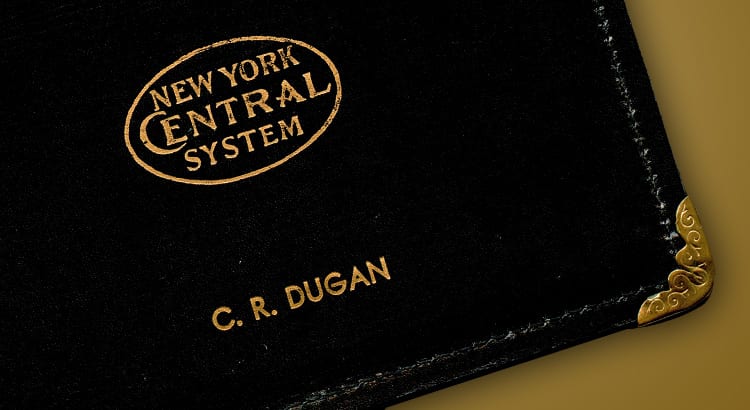
At least a year ago, maybe even longer, when I first became interested in railroad timetables, I made a little poster showing some of the New York Central’s system timetables over the years. I had just begun to appreciate the functional art that is a timetable, and the little portion of me that endured many art history classes began connecting the stylistic choices with the events of the time. And probably just like every paper I wrote for an art history class, it was comprised of complete and utter bullshit. It seemed to make sense at the time, at least I think it did. Maybe it makes some sense. Hell, maybe it makes complete sense, and logically explains why there were so many stylistic changes on the timetables over the years. I had every intention of posting it, after it was completed. After I, I don’t know, verified some of the grandiose claims that I made? But I never did that. And this sat. And sat. And sat some more, in the dark little recesses of my hard drive, covered in spiderwebs, with crickets chirping merely to hear their own voices, out of complete and utter loneliness.

Today, however, I am crazy enough to post this, mostly because the former project, which I had high hopes for, was calling out to me for some reason. It wants the chance to see the light of day. I doubt I’ll ever do anything with this beyond this post, but if there are any other art-slash-rail-history folks out there that would like to discuss this, I might enjoy that.

Railroads, Mansions and Money: The Vanderbilts in a nutshell History

Friday, January 14th, 2011

There is a lot of wrong information, or downright confusion, when it comes to the Vanderbilts on the internet. I’ve seen articles saying they earned their fortunes in the 1930′s, and that Gloria Vanderbilt’s father was the man who made the millions. But the family has origins much earlier than that, with the “Commodore Cornelius” Vanderbilt. Can I fault people for the confusion? Not really, considering that there were six or more men named Cornelius, at least five Williams, and several George Washingtons. It is my belief that all New Yorkers, and everyone that ever steps through Grand Central, ought to know about the Commodore and his family that had so much influence on our area. It was he that united New York state’s oldest railroad, with New York city’s oldest railroad. The family that built the New York Central railroad into an empire, and constructed our wonderful monument, Grand Central Terminal. So, if you were ever confused about the Vanderbilts, hopefully they’ll now make more sense to you… as I present to you, the Vanderbilts in a nutshell.


Vintage Holiday & Winter New York Central Ads Train Advertisements

Friday, December 24th, 2010

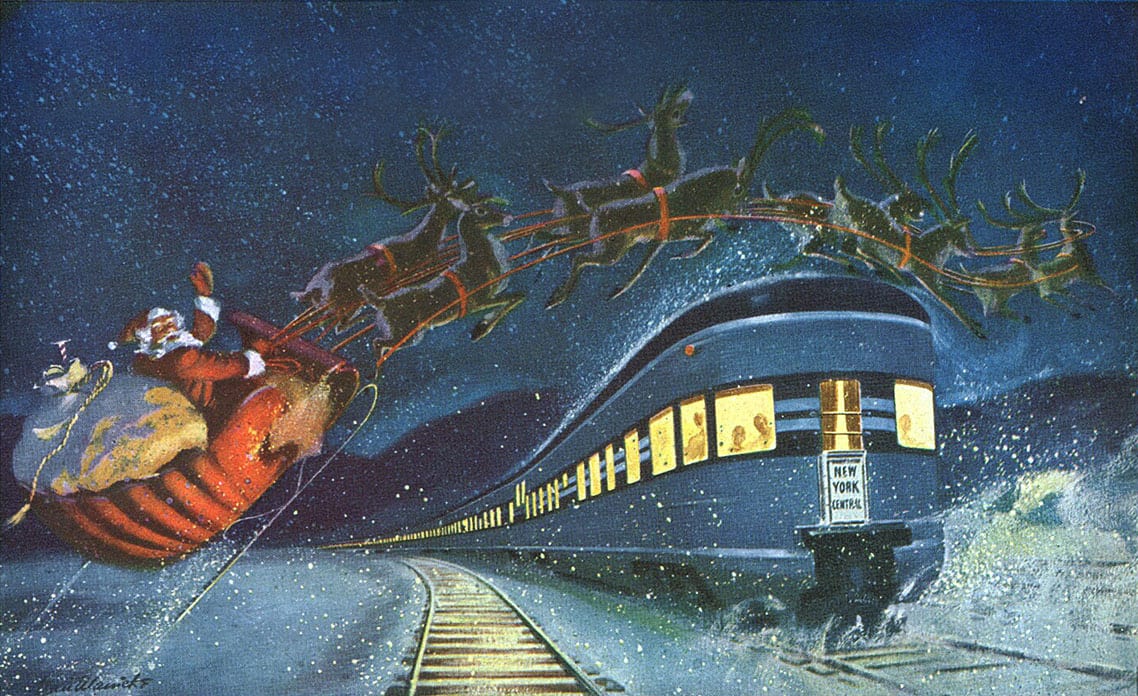
Hopefully all of my readers that celebrate Christmas are enjoying your Christmas Eve… Did I ever mention that I love looking at vintage ads?`Even better are vintage railroad ads. Here is a little collection of holiday and winter ads from the New York Central. Have a great holiday, everybody!


If you liked these ads, check out another set of New York Central vintage ads from World War II that I posted back in June.

Holiday Trains & Old Holiday Timetables Train

Monday, December 20th, 2010

Looking to take the train for the holiday? Metro-North has you covered with pre-Christmas early getaway trains, Christmas eve, and Christmas day service, as well as New Years trains. Check out the Holiday Service page on the Metro-North website, or the Early Getaway Trains schedule on their Facebook page.

And if you’re in a particularly holiday-cheerful mood, check out some railroad holiday/winter brochures and timetables from my collection…