TrainsHistoryObservationsHumorAdvertisementsEventsMuseumsPhotosVideosTuesday ToursPost ArchivesHistorical ArtifactsPanorama ProjectRSS FeedFollow us on twitterSubscribe by email Home

Posts Tagged ‘metro north’

Tuesday Tour of the Hudson Line: Yonkers Train Photos

Tuesday, July 17th, 2012

Although Grand Central Terminal may be the obvious gem of the Metro-North system, interspersed along all three of the main lines are many other beautiful stations. On the New Haven Line, I can’t help but think of New Haven Union Station, and of course Mamaroneck. On the Harlem, I’ve always loved both Brewster and Chappaqua. By now I’ve explored much of the Hudson Line, and it seems that the standout stations there are definitely Poughkeepsie and Yonkers. Both are well-restored examples of brick stations built by the New York Central in the early 1900′s. Though smaller than Poughkeepsie, Yonkers makes up for that with beautiful detailing on the outside, and a gorgeous entranceway and waiting room on the inside. On today’s tour we may have discovered the most beautiful station on the Hudson Line.


Postcard and ticket from Yonkers. The card lists various facts about Yonkers – like Yonkers having nineteen railroad stations.

The city of Yonkers is the fourth most populous in New York state, and the most populous city in Westchester county. Reflecting that population, Yonkers was historically well-connected to the city and beyond via multiple methods of transportation. Right near the station were steamboats and ferries, various streetcars, and the Getty Square branch of Putnam Division was not far away. At one time, Yonkers had nineteen railroad stations. Today there are far fewer than nineteen stations, the streetcars are long gone, and the Putnam Division is just a memory. However, Yonkers still has quite a few connections to the city via Metro-North – Ludlow, Glenwood, and Greystone are all in Yonkers. And the primary Yonkers station, which we are visiting today, is serviced by both Metro-North and Amtrak.


Some of the now defunct methods of transportation in Yonkers – including trolleys and a few Putnam Division stations. Postcards from the collection of the awesome postcard master, Steve Swirsky.

Other than being beautiful stations, Grand Central Terminal, Poughkeepsie, and Yonkers do have one thing in common – all were worked on by architects Warren and Wetmore. Built in their signature Beaux Arts style, the station was completed in 1911. The Gustavino tiling on the ceiling of Yonkers significantly resembles the portion of Grand Central adjacent to the Oyster Bar. One of my favorite portions of the station is the sculpted detail work containing NYC – for the New York Central. The station still has the original ticket windows, which are quite attractive, but they are no longer in use. All ticketing at Yonkers is through Ticket Vending Machines.


Postcards of Yonkers station, from the collection of Steve Swirsky

Expectedly, Yonkers station fell into disrepair over many years. It was ultimately restored by Metro-North in 2001. $45 million was alloted for the work at Yonkers, $4.5 million of which was for restoring the building itself. The sculpted terra cotta on the façade of the building was restored, or in some instances, replaced by a company from California. The rest of the money was used for track work, reconstruction of steel bridges, and refurbishment of the viaduct. Platforms were also redone, the lighting improved, and accommodations made for the disabled. In 2006 an Arts for Transit piece was added at Yonkers, but I happened to miss it on my visit.

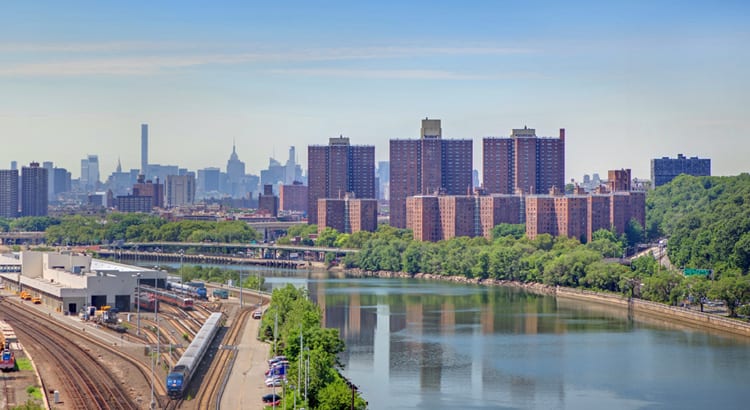
Occurring simultaneously were other initiatives to renew the waterfront area surrounding the train station in Yonkers. One such effort was the Hudson Park luxury apartments, which you can spot in the background of several of my photographs of the station. Its proximity to the train station no doubt makes it an attractive place to live, and you’ll notice many developments similar to this up and down the line.

Compared to the beautiful station, the platform area of Yonkers station is relatively underwhelming. But it is, of course, from the platform that one accesses the frequent trains heading south to the city, or north to Poughkeepsie and beyond. Yonkers is just over 14 miles from Grand Central, a ride that takes on average 30 minutes. 26 daily Amtrak trains make stops at Yonkers, and there are Metro-North trains every half hour, if not more frequently.

That is about all I have for Yonkers today. Next week we will visit another Hudson Line station, but I can’t promise it will be quite as beautiful as this one. ;)


Pac-Man Inspired Transit Maps Train

Thursday, July 5th, 2012

The subtitle of this post might as well be “stuff that happens when Emily gets bored.” For some reason I thought it might be amusing to make a completely useless Pac-Man transit map, where all the little dots Pac-Man eats could be stations. Besides maybe looking cool, they’re not going to help you get anywhere… hence my classification of “useless.”

Timetables on the Pascack Valley Line History

Thursday, May 31st, 2012

I’ve been joking around recently that the next time someone asks me why I like the Harlem Division/Line, I am going to answer that “I am a girl, and I like the color blue.” Because clearly female railfans choose their favorites based upon color! If that were the truth, then my second favorite line would have to be the Pascack Valley, as the color for that line is purple. Much to my chagrin, none of Metro-North’s printed timetables for the line are actually printed in purple (so I had to make a fake one – which is below). New Jersey Transit, however, does print timetables for the Pascack Valley line, and they are purple! Since we’re now touring the Pascack Valley line (and I not-so-secretly love old railroad timetables), I figured it would be appropriate to check out some of the printed materials that have been used over the years.

A few of the older timetables you’ll notice use the name New Jersey and New York Railroad, which was used up until the Erie-Lackawanna merger. You’ll notice that the one EL timetable I’m posting from 1969 does actually use the name Pascack Valley. Most of the timetables I have for show are more current, from both the New Jersey Transit and Metro-North. I’m sorry to have to say it, but the NJT timetables are quite a bit nicer, and actually purple. Metro-North has always been all about trying to cram as much junk onto the front of their timetables as possible… which is not necessarily the most aesthetically pleasing. The newest east-of-Hudson timetables have a horrible and cheap-looking drop shadow, at least the west-of-Hudson timetable missed out on that crappy treatment!

Can’t we just go back in time to the late 1800′s or early 1900′s when timetables were beautiful and actually looked like this?


Early timetables from what is now known as the Pascack Valley Line. From the collection of (the awesome) Otto Vondrak.


New Jersey Transit’s timetables for the Pascack Valley line feature the color purple, and a pine tree, both of which represent the line. Although Metro-North also uses the color purple to represent the line, they do not make use of the pine tree image.


Current NJ Transit timetable for the Pascack Valley Line, and two older Metro-North timetables.


Metro-North does not print a separate timetable for the Pascack Valley line – it is combined with the Port Jervis Line and colored orange. I wanted a purple Pascack Valley timetable though, so I faked it!

Tuesday Tour of the Port Jervis Line: Port Jervis Train Photos

Tuesday, May 22nd, 2012


Stereoscopic view of the Erie Railroad near Port Jervis, circa 1870. From the collection of the NYPL.

Finally, we have arrived – the eponymous and final station along Metro-North’s Port Jervis Line. Port Jervis is located at the edge of Orange County, and bordered by the Delaware River. The river’s natural border splits New York and Pennsylvania, and the railroad station is within easy walking distance with border-town Matamoras, PA (New Jersey is also not too far, but the walk would be a little bit longer). While Matamoras tends to be known as “that place across the border where out-of-staters can buy fireworks,” I’d certainly suggest you not do this by train (although people have tried to bring some pretty crazy things on Metro-North trains before!).


Train at the Erie Port Jervis station, 1966. This station still stands, but has been converted to shops and is not used by the railroad.

The original Erie train station at Port Jervis is a beautiful building, constructed in 1892. However, when Metro-North took over commuter operations here, they constructed a new station about a quarter mile beyond the old station. Today, the original station is home to various shops, and is in very good condition after being renovated. It, of course, significantly overshadows the utilitarian Metro-North station that we are here to visit today. I won’t be talking more about the Erie station now, since it is certainly worthy of its own post, which I will hopefully get a chance to put up before the end of the week.


Hanging out at Port Jervis, 1988.

Similar to the other stations along the line, Port Jervis has a low-level platform, shelter, and not much else. Metro-North did a little bit of renovating within the past year (at a cost of about a million dollars), and now the shelter is actually heated. Other modifications were to be made to better accommodate passengers with disabilities. Located beyond the platform is a small yard facility where trains can be stored for service on the line, which is slightly less boring than the station. There is also a historic turntable not far from the station, but I’ll talk more about that in my post about the Erie station. Until then, here are some views of Port Jervis.


Random photos from a weekend full of trains… Train Photos

Monday, May 14th, 2012

I hope everyone had a spectacular weekend… Although I managed to get slightly sunburnt, we certainly had some lovely weather! Maybe you even partook in some of the events for National Train Day in Grand Central? I saw quite a few of you there, apologies to the folks I never got a chance to meet up with and say hi.

My weekend was quite full with Train Day festivities, as well as my first photographic foray to the foreign territory that is the Hudson Line. At Poughkeepsie I achieved the milestone of my 100th Metro-North station photographed. When you think about it, I mostly take pictures of stations, not trains (though stations do look better when there are trains present). But there was certainly an exception to that over the weekend, as I managed to snap quite an array of trains in various places along all three lines. Want to know how my weekend was? It is far easier to show you in photographs than it is in words – so here is a little bit of randomness from the past few days.


Tuesday Tour of the New Haven Line: Mamaroneck Train Photos

Tuesday, February 28th, 2012


Postcard view of Mamaroneck station


Aerial view of Mamaroneck. The old station is to the left, away from the tracks and platform.

Welcome to one of the final Tuesday Tours of the New Haven Line. Our stop today is the delightful village of Mamaroneck. I had every intention of posting Mamaroneck last – I even had Darien’s tour ready to go – but I happened to get a sneak peek of the newly-restored station over the weekend, and couldn’t resist posting it right away. The station, built in 1888 in the Richardsonian Romanesque style (which, admittedly, is one of my favorites), is certainly one of the nicest (and second oldest) on the New Haven Line. However, like many old stations, the condition of the building had degraded, and it needed a lot of work. Metro-North, who owned the station, was having difficulties finding someone to lease the place in the condition it was in. Without the funds to renovate the station themselves, Metro-North instead listed the station for sale in 2007.


Drawing of Mamaroneck station, front view

Though various parties were interested in the station, it was ultimately sold in 2008 to John and Chris Verni of Verco Properties, for $1.25 million. Renovations began after a formal groundbreaking ceremony on April 22, 2010. During my first visit to Mamaroneck last September, I happened to get a few shots of the station while the restoration was in progress. It didn’t look like too much had been completed yet, but I was feeling very optimistic about this place, and knew I would return at some point.


Work on the Mamaroneck station, photos taken September 2010

Curious about the station’s progress, I decided that a visit to Mamaroneck was in order last weekend. After attempting to peek through the windows, one of the staff members that was there invited me in. Getting a sneak peek of the renovated station, and its tenant the Club Car restaurant, was certainly the highlight of my weekend. Hopefully the restaurant will be open within the next two or three weeks (I was told they are still waiting on Con-Ed), but I’m happy to share with you all a little preview of this great former rail station. And it sure looks beautiful!


The real reason we’re here, however, are the trains. Mamaroneck is one of New York state’s stations along the New Haven Line. Located a little more than 20 miles from Grand Central, a journey to the city takes around forty minutes. The station building, which we saw above, was once closer to the tracks, but was moved to its current location in 1927. This placement did make it a little difficult to serve as a ticket office, since it was so far from the tracks. The building was, however, connected via a tunnel to stairways leading to both platforms.


Tickets stamped in Mamaroneck, from the collection of Otto Vondrak

Metro North’s current facility at the station consists of a covered platform, and a small waiting area with benches and soda/snack machines on the westbound side of the track. Up until 2007 the historic station was used as a ticket office, but it was closed ahead of listing the building for sale. There are, however, ticket vending machines on the platform to serve this purpose.

That is about it for our tour today. I’ll end with some photos of the platform at Mamaroneck, and a few sightings of the new M8 railcars there. There are only two stations left on this Tuesday Tour of the New Haven Line – Darien and Stamford. Anybody want to have a tour finished/railfan get-together at the Club Car when it opens?


Tuesday Tour of the New Haven Line: Fairfield Train Photos

Tuesday, February 21st, 2012


Postcard view of Fairfield station

Welcome to Fairfield, the next stop on our tour of the New Haven Line. Although it isn’t as hip as the new Fairfield Metro station, it does have a bit of history – including an 1882 station listed on the National Register of Historic Places. Located just over 50 miles from Grand Central, a train trip to the city from Fairfield takes about an hour and fifteen minutes.


Many of today’s historical images of Fairfield station have come from a site called Tyler City Station, which is filled with information about Connecticut stations, and is quite wonderful. It is definitely worth checking out.

One of the nice things about New Haven main line stations are the configuration of the tracks. Instead of having an island platform, like a lot of Harlem Line stations, there are two platforms – one on each side of the four tracks. Because of this arrangement, there were usually two station buildings, one on the New Haven (or eastbound) side, and one on the New York (or westbound) side. While many stops along the line have only retained one of their stations, Fairfield has managed to preserve both.

 
Diagram of the tracks and station buildings at Fairfield

Fairfield’s eastbound station is the oldest of the two, a brick building constructed in 1882. The building measures 26 feet by 82 feet, and is one and a half stories in height. The inside has high ceilings and hardwood flooring. The old waiting room is used by a taxi company, and the building also contains a restaurant and cleaners.

The westbound station is constructed of wood and measures 30 feet by 90 feet. It also has hardwood flooring, and is partially occupied by a coffee shop. There is a small waiting area that once served as a ticket office, but Metro-North closed that window in 2010. The design is similar to several other stations we’ve featured, as reusing the architectural plan for multiple stations was a method of cost savings for the railroad.


Because we’re all fascinated (or at least I am) with train crash images, here is one in Fairfield.

  
Photos of Fairfield in 1988, from the application for listing the station on the National Register of Historic Places.

That is about all I have on Fairfield, and for our tour today. At the time of my visit there was some construction going on, and some tracks were out of service. You will note in several of the photos that trains were boarding from temporary wooden platforms, instead of the normal concrete side platforms, because of this construction.


Remembering Metro-North in 1986… Train History

Thursday, February 9th, 2012

Back in February of 1986 I had not yet reached my second birthday… I’m not too familiar with the milestones of an aging child, so for all I know I could have still been wearing diapers at that time. Metro-North, founded in 1983, was a fledgling organization. Though we may be similar in age, Metro-North didn’t seem to have much of a “diaper wearing” stage. In terms of the Harlem Line, they hit the ground running – beginning major renovations to the line. The tracks were electrified from North White Plains to Brewster North (Southeast), and over 10 million was spent on upgrading Brewster yard (aka Putnam Junction) and shop. Metro-North was also trying to reach their customers – printing several guides to explain to riders what they do, and give a brief tour of the system.


I’d like to have one of these in my backyard. The loco and the castle.

Since SmartCat debuted about two weeks ago, I’ve still been working on adding plenty of new material for you all to peruse. Two of the newest things found in the catalog are two brochures Metro-North released in or around 1986. One was a guide to the Metro-North system, the other a Grand Central and Customer Service guide.

Just spotting the little things that have changed over the years is quite fun. It was a time where terrorism was not as much of a concern, and the Terminal had a room where you could temporarily store your bags. And people weren’t quite so health conscious either – Harlem and Hudson trains each had one car reserved for smokers, the New Haven Line had two. Vanderbilt Hall was still a waiting room, and many of the updates – including the other stairwell in the main concourse, and the cleanup of the sky ceiling – in Grand Central had not yet been made. Amtrak trains still stopped at the Terminal, and places like Crugers and Kent Road were still stops listed on the system map.


The old Omega departure board can be seen in one of the brochures. It was replaced by an LCD Solari board in the late 90′s.

You should definitely check out SmartCat if you haven’t already, or if you want to jump right to the aforementioned brochures, you can use these links:

1986 Guide to Metro-North
1986 Grand Central Customer Service Guide

As an addendum to this post, as I’ve gotten a few messages regarding adding things to SmartCat, I would absolutely love user submissions. If you have anything that you think would be archivable, whether it be a timetable, postcard, ticket, etc… send me a message. I’d love to add it!

SmartCat, your guide to the Harlem Line History

Friday, January 27th, 2012

Several years ago when I really started getting interested in the history of the Harlem Line, and began collecting old timetables and artifacts, I had the grand idea that I would create a “digital museum” for the line. Although I attempted it with the “Harlem Line Historical Archives,” the archives were poorly organized, extremely clunky to find anything, and extremely time consuming to update. In an effort to create something better, I began work on SmartCat last summer. I had been hoping to launch it in the fall, but it never happened. Six months later, and long overdue, I am pleased to finally launch SmartCat.

In SmartCat you will find scans of over 300 artifacts related to the Harlem Line, ranging from 1857 to today. All items are tagged for easier browsing, and the system has a built-in search engine – an important upgrade from the old archives. The overwhelming majority of the artifacts currently available in SmartCat are timetables and postcards. Right now, only the covers of the timetables are scanned. Although it will be a massive undertaking, I hope to scan the insides of some of these timetables and make them available as well.

I’m going to quit talking about SmartCat – because you really need to be checking it out for yourself. You can use the below “guide” to the system, or click here to view everything.

SmartCat Search

Looking for something specific?

View all archived items

Counting down the 12 most popular posts of 2011, Part 1 Train

Monday, January 2nd, 2012

2011 was certainly a whirlwind of a year. The site found itself featured in the New York Times, and I even had a radio interview. There were visits to lots of interesting places: train stations in Quebec, South Africa, and Zimbabwe, and non train related spots like an ice hotel, and the final space shuttle launch. In February we finished up our tour of the Harlem Line, and by May began our tour of the New Haven Line. As we head boldly into the new year, hoping for many new and wonderful adventures, I thought I’d take the time to check out the top 12 things you loved about 2011.

Although not eligible for a spot in our 2011 countdown, as it was posted in 2010, the Panorama Project page was hands-down the most popular page on the site this year. Likely the New York Times article had a lot to do with that. Although we post a new station every Tuesday, the Panorama Project page is still the best way to check out all the stations and lines that have been featured thus far.

Number 12 on our list is The Rebirth of a Train Station: Canaan. While so many towns are content to ignore their railroading history, Canaan is the complete opposite. They are fiercely proud of that history, and when their gorgeous station was the victim of arson several years ago, they vowed to rebuild. In the ensuing years, the old depot has made a huge transformation – no longer is it a fire-ravaged hulk – it is slowly returning to its former grandeur.

Later in the year, we revisited Canaan during their annual Railway Days.

Old postcards have always been a popular subject matter on the site, and over the years there have been six parts (and more to come!) in our Sending Postcards from the Harlem Line series. Part two was the eleventh most popular post on the blog in 2011. You can check out all the other postcard posts with the following links: Part 1, Part 3, Part 4, Part 5, Part 6.

Tenth most popular in 2011 was one of our Tuesday Tour stops on the New Haven Line, Pelham. Pelham is one of the old and attractive New Haven Line stations on the opposite side of the border, in New York. I found myself here on the very day that the article featuring the site was published in the New York Times. And the fact that this post was linked to by a few other railroad websites certainly helped with its popularity.

A bit more popular than the postcards are our collections of old photos from the Harlem Line. Like the postcards, there have been many different old photo posts, and for a brief stint I posted many of these photos on Mondays. Part 3 of Even More Monday Morning Old Photos was the ninth most popular post on the blog in 2011. It contained several photos of the line that used to be, when it passed by Millerton and extended all the way up to Chatham.

Everyone must admit that the concept of quiet cars is a great one – however, in practice, it may be a little bit more difficult. You know that although you may encounter some really nice people on the trains, there are also a whole bunch of assholes. They yap on their phones, take up rows of seats with their bags (one morning I saw a woman holding hostage several seats with her large carton of juice). There are many times that I am skeptical that good ideas can work with stupid people.

Before the quiet car program started, Metro North said that conductors would have “Shh Cards” to pass out to loud people to tell them to shut their traps in a nice, passive way. I thought the idea was amusing, and managed to get my hands on some of the cards before the program debuted. And they were a little bit too nice – I was unable to resist making modifications to them… and even printing out a few. The fake shh cards posted under the title of Quiet cars and Shh cards was the eighth most popular on the site in 2011, and the cliffhanger I’ll leave you with until later on this week.

Want to see the remainder of the top 12? Check back later this week to see them, and to find out which post will be crowned number one most popular of 2011.