I Ride the Harlem Line - HomePosts about the trainPosts about observationsHumorous postsPosts about advertisementsPosts about eventsPosts about eventsPosts about museumsPosts with photosPosts with videosPost ArchivesRSS FeedTwitterYouTubePanoramio

Posts Tagged ‘harlem’

Millerton, Revisited & the Harlem Valley Rail Ride Train Photos

Friday, June 3rd, 2011

You know how I said I really liked Chatham? Well, I’ve recently discovered that I like Millerton even more. Millerton is quite charming – and if the railroad still ran there I would probably consider even living there (but the commute would probably kill me). My most recent visit was only the second time I’ve been to Millerton, and of course I had my camera. This time I was able to get photos of the original train station there, built in the 1850′s, though it has been moved at least twice since then. Today the former station operates as a florist.

Millerton itself was a town created pretty much around the railroad. The New York and Harlem Railroad ran through, as well as the Central New England. In fact the name Millerton came from the civil engineer tasked with the construction of the rail, Sidney Miller. Though both of those railroads are long gone today, the town hasn’t lapsed into loneliness and disarray. The Main Street area bustles with people checking out the shops, or using the rail trail. So many towns today are filled with chain and big-box stores and are utterly devoid of character. Millerton is the complete opposite – full of family-owned shops, and old-fashioned in a charming way, yet doesn’t feel dated.

Though the rail is no longer there, the converted rail trail is an attraction that brings in locals and visitors from beyond. The other day I read an article discussing options for bikers from the city that wanted to get out, ride, and make a day of it. By Metro-North, one has two pretty good options for spots: Poughkeepsie on the Hudson Line, and Wassaic on the Harlem Line. Although the article knocks the Harlem down in terms of the view on the journey (I know, I know, the Hudson River is beautiful), it ultimately determines that the Harlem journey is probably the best choice for the biker. The Hudson option provides around 5 miles of trail on which to ride, where the Harlem extends for nearly 11 miles, terminating in the village of Millerton. If you ask me, I’d take Millerton over Poughkeepsie any day, no contest.


In other news, I figured that I would mention the Harlem Valley Rail Ride, which appropriately begins in Millerton and covers some of the original route of the Harlem Division (and of course is now part of the rail trail). The ride will be held this year on July 24th. For anyone that needs, there will be a bus that will pick up riders and their bikes from the city and take them to Millerton. Riders have a choice between 25, 50, 75, and 100 mile routes.

A portion of the fee for entry goes to the cause of supporting and maintaining the Harlem Valley Rail Trail. For more information, be sure to check out the Harlem Valley Rail Ride website.

Book available for download: The History of the New York & Harlem Railroad History

Wednesday, April 20th, 2011

When it comes to the history of the Harlem Line, you can’t beat The Coming of the New York & Harlem Railroad, by Lou Grogan. It is, by far, the most complete history of the line, and full of wonderful pictures. There was, however, another book written on the New York & Harlem, covering the line’s early history many years prior. I had been trying to get my hands on it for a while… I know of only three copies that exist: the one I didn’t win on eBay, one that belonged to Gouverneur Morris, Jr., and is now in the collection of the New York Historical Society, and one that belongs to the Katonah Village Library. The book was written by Clarence Hyatt in 1898, so it is hardly something that bookstores or even internet booksellers have. The only thing I knew about it was that it was quite small, about 36 pages. Beyond that, I knew nothing of what was inside.


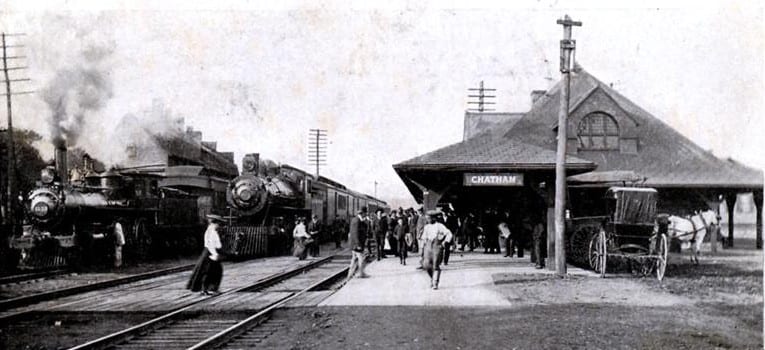
Photo of Chatham from the book, taken at some point in the late 1800′s

I finally got off my butt and made the trip to the library in Katonah on one of the days we had warm weather. I’d never been to the library before, so I didn’t know what to expect, or whether the book would even be in a “public” area. The person at the front desk was rather snippy with me when I asked her to help me find the book, despite me saying I had never been there before and had no idea where to look. I told her that I figured the book would probably be in a special section, given the fact that it is over a hundred years old… and she told me to go talk to the reference librarian. Thankfully, the reference librarian was kind and helpful. The book was in a locked cabinet, and I took it to a couch, where I read it in short order.

And then, of course, I digitized it. I would have much rathered to scan it, to get a better quality, but I ended up just photographing each page. The majority of the book is text, though there are a few photographs: two of Chatham, one of Mount Kisco, and another of Chappaqua. It does have some pretty cool little anecdotes about general rail history, and the history of the Harlem.

Did you know that Peter Cooper, other than having absolutely amazing facial hair, was the designer and creator of the first steam locomotive in the US, a locomotive which could only attain a speed of eighteen miles-per-hour? I didn’t.

Amusingly, the book details people opposing railroads, and not for things that at least make sense – like the noise of the locomotives. No, people protested because they thought that railroads would effect animals: preventing cows from grazing, causing hens to stop laying eggs, and railroads would lead to the destruction of birds. But then there were also people on the opposite side of the spectrum: the citizens of “primitive” and rural areas, such as Dover Plains, that gazed at locomotives for the first time with intense curiosity.

In the continued celebration of Harlem Railroad Month, I am happy to share this wonderful book. It is a relatively short read, but an interesting one.

[pdf-ppt-viewer href="http://www.iridetheharlemline.com/ny_harlem.pdf" width="600" height="500"]

If you’d prefer to download the book (or the above preview doesn’t work), please right click on this link, and choose to save the target as.

Chatham: Revisited Train History Photos

Wednesday, December 29th, 2010

I’m not exactly sure why, but I have a strange affinity for the village of Chatham. Although it is an adorable place, rather quaint, I wonder what exactly it was like when the railroads ran through here. You might see a freight train, or a passing Lake Shore Limited, but none of them stop. Chatham once serviced the New York & Harlem Railroad, the Boston & Albany, and the Rutland – all of which are long gone. And thus the place is a little bit of a curiosity to me. The many suburbs along the Harlem – Bronxville, Hartsdale, Scarsdale, and even the ones further north, Katonah, Brewster – they were all influenced by the rail. They grew and morphed into the places we know now, and though the rail does not entirely define those places now, the rail still is there, playing a part in the futures of those areas. But Chatham, it is a special case. The single most defining factor of the village has disappeared. It is no longer the terminus of any railroads. The once busy Union Station no longer serves train riders, it is a bank. Chatham has reverted to a quieter version of itself, representing a little portion of historical Columbia County.

Many places across the country have seen transformations, with the things they were built upon playing a part in their downfall. Detroit was built on the auto industry, but as the industry migrated and moved overseas, parts of the city have become abandoned – a true example of urban decay. The small town of Centralia, Pennsylvania was built upon anthracite coal, literally and figuratively. Ironically, it was the coal brought the death sentence of the little town, as it caught fire in the 1960′s and has been burning ever since. There is something about these changed places that intrigues me (high on my list of places to visit is also Pripyat, an abandoned town brought down by the failings of humans). All of these, of course, are radical examples. Chatham lives, it does not decay. Perhaps the once-fundamental core of its being is gone, but it still thrives. But just as one can compare the photos of Detroit’s urban decay with the historical photos of yesteryear, one can bear witness to the radical changes made in just a few scant years (or slightly longer than the years I’ve been on this Earth). There are no more signal towers, water towers, or turntables. The children of Chatham will never board a passenger train in their village to head the one hundred and twenty seven miles to Grand Central. And of course, the Harlem division will never again run this far north.

The time for Chatham as a railroad town has passed. As the time has ticked by it has reinvented itself, and is still reinventing itself. It is not the decline as a railroad hub that has intrigued me about Chatham, but that reinvention. It is a charming and beautiful little village, with a gazebo, clock tower, shops, and restaurants – plus a whole lot of history. The photos below were taken back in October upon my second visit to Chatham, a visit where I actually had time to shop and eat, and enjoy the surrounding history. Perhaps if you too find Chatham to be interesting you will take the time to visit some day…


The photos below were sent in by reader John. They were taken in the late 1960′s at Chatham.


For an even further back look, the Library of Congress has an illustrated map view of the village of Chatham from 1886. At this time the “Union Station” had not been built, and the Boston & Albany, and the New York & Harlem each had their own rail stations. For easier viewing I’ve given the B&A station a slight red tint, and the Harlem a blue tint.

Tuesday Tour of the Harlem Line: Tremont Uncategorized

Tuesday, December 21st, 2010

The next time you’re riding a train out of Grand Central, give a little wave goodbye when you pass Tremont station, at mile post 7.9. For Tremont is a lonely station – it may have four tracks, and it may see every Harlem and New Haven line train pass by, but only a handful of them stop. Like Melrose, Tremont is a Bronx station with somewhat more limited service than most other Harlem Line stations. During non-rush hours, that means a train about every two hours. Tremont is also small – the platform can accommodate only two train cars.

Enjoy this quick look at Tremont station through various panoramas… This pretty much wraps up our tour to the Harlem Line’s more limited service stations. Melrose and Tremont are like the big brothers of the bunch, as their limited service is much more often than the once or twice per day Mount Pleasant and weekend-only Appalachian Trail. These are the final weeks of my Tour of the Harlem Line, as I’ve featured most of the stations so far. Next week we’ll go and visit Crestwood, the last station to be featured that was part of the Mid-Harlem Station Improvement project (all of which have photos preserved in the archives of the Library of Congress).


Holiday Trains & Old Holiday Timetables Train

Monday, December 20th, 2010

Looking to take the train for the holiday? Metro-North has you covered with pre-Christmas early getaway trains, Christmas eve, and Christmas day service, as well as New Years trains. Check out the Holiday Service page on the Metro-North website, or the Early Getaway Trains schedule on their Facebook page.

And if you’re in a particularly holiday-cheerful mood, check out some railroad holiday/winter brochures and timetables from my collection…


Tuesday Tour of the Harlem Line: Patterson Train Photos

Tuesday, November 9th, 2010

When I first began riding Metro-North to the city I was fairly young… and at the time I had always assumed that Brewster North was the end of the Harlem Line. It was my train’s last stop, after all. It is around this time of year that there is an influx of young riders, off to see the city’s Christmas decorations, the tree that will soon be in Rockefeller Center, and perhaps a visit to see the Christmas Spectacular at Radio City (for which I was riding the train). You can always tell who these children are – they come back and board the trains with obnoxious little gizmos that spin around and light up, items that probably cost mere cents to produce in China but get peddled to small children for a significant markup of around twenty dollars. Not only was I the obnoxious child that insisted on having that toy – for God’s sake it actually lit up – but I was that obnoxious child on your train.

It certainly has been a lot of years since then… I’m hopefully less obnoxious on the train, and I know that beyond Southeast – what Brewster North is now called – there still is more to the Harlem Line. The first stop north of Southeast – beyond the electrified tracks, located 60 miles north of Grand Central – is the last stop in Putnam County: Patterson. There is one track here, as well as a platform that will accommodate four train cars. It is a small station, but it does have the amenities we have come to know: automated ticket machines, and a shelter for waiting in the cold (great for days like yesterday).

If the quiet nature of Patterson station is not quite your thing, and you are looking for a bit of adventure, I’d suggest visiting Texas Taco. It is also in Patterson and not far from the station. Adjectives that come to mind when describing the place are colorful, slightly creepy, and “holy crap that lady has purple hair.” But that isn’t a bad thing, is it? Before I had cat hats, I used to have blue hair – but that too was a long time ago…


A little bit of old reading… Train History

Friday, October 22nd, 2010

If I haven’t mentioned it before, I am a big fan of both Project Gutenberg, and Google Books. Both have available many old books free to read. And who doesn’t like free? If you find yourself interested in the history of the railroads in our area you can check out some of these books (and portions of books) from the 1800′s and early 1900′s.

A nice book about the history of railroads in the United States. The first chapter is a synopsis of rail history, and the second deals with Commodore Vanderbilt, and the New York Central Railroad.

The railroad builders: a chronicle of the welding of the states, Published 1919
Download an excerpt (first two chapters) here, or view the whole thing on Google Books.

For those interested in the Hudson Line, check out this book about the Hudson River Railroad:

Hudson River and the Hudson River Railroad, Published 1851
Click to view on Google Books

I’m currently reading the autobiography of Chauncey Depew, over his 93 years he served as Secretary of State for New York, as well as a senator, not to mention many years working for the railroad. He was the attorney for the New York and Harlem Railroad, and later became president of the New York Central. He mentions in his memoirs that he almost turned down the position when Vanderbilt offered it to him, as he had also just been offered a position as US Minister to Japan which paid more. Vanderbilt told him, “There is nothing in politics. Don’t be a damned fool.”

My Memories of Eighty Years by Chauncey Depew
Download this book from Project Gutenberg

Anyone else have some interesting books saved in their library on Google Books? Let me know! You can view my library here.

Tuesday Tour of the Harlem Line: Mount Vernon West Train Photos

Tuesday, October 12th, 2010

As a city, Mount Vernon is well connected to New York through the Metro-North system. There are three train stations in the city: Mount Vernon East on the New Haven Line, and Fleetwood and Mount Vernon West on the Harlem Line. The city is at the south end of Westchester County and borders the Bronx. In fact, from the south end of the platform at Mount Vernon West, you can see the Wakefield station, the first Harlem Line station after crossing into the Bronx. Wakefield and Mount Vernon are also historically linked – both of their names come from plantations associated with George Washington: Wakefield where he was born, and Mount Vernon, where he died.

Mount Vernon West’s current station building was built in 1915 and was designed by Warren & Wetmore. The New York Central later sold the station building in 1959, but retained ownership of the passageway to the platforms, and the platforms themselves. Today the passageway contains automated ticket machines, and hung on the ceiling has an Arts for Transit piece. The glass and ceramic mosaic sculptures were done by artist Martha Jackson-Jarvis, and installed in 1991. When I was there I think I was so caught up looking at the ceiling I never even went out to see the front of the station – so whenever I happen to stop by Mount Vernon West I’ll have to do just that.


Panorama Project on Google Maps & Sunset Over Port Jervis Train Photos

Sunday, September 19th, 2010

I’ve been on a little map kick recently – I signed up for Panoramio, so a bunch of the station panoramas from the site now show up in Google Earth. I also made a map on Google of all the locations photographed for the panorama project. Harlem Line stations from the Tuesday Tour have the blue placemarks, and other locations I’ve photographed have the pink placemarks.


View larger map

And just for kicks, here are two panoramas of the sunset over Interstate-84 around Port Jervis. I took these on the way home from Steamtown in Scranton a few weeks ago.


Nature along the Harlem Line: The Muscoot Reservoir & Bridge L-158 Photos

Friday, September 17th, 2010

I thought it might be fun to do something different this Friday… Tuesdays I visit train stations, but I don’t talk much about what else is around the station. The Harlem Line has plenty of intriguing spots along the route, and many for the nature lover. I do get emails every once and a while asking me questions about doing things – people wondering what is within walking distance of the stations, and what they can get away and do. And for those who, like me, do not drive, or don’t feel like driving, you can definitely take Metro-North to get to interesting spots.

As I mentioned, there are many nature-related locales on the Harlem Line. Some of the obvious ones are the Botanical Garden and the Appalachian Trail, but there are many lesser-known spots. Pawling has the Pawling Nature Reserve, which is not far from the Appalachian Trail. At the end of the line in Wassaic is the trailhead for the Harlem Valley Rail Trail which follows the old route the Harlem Line once took further north. Lower Westchester has the Bronx River Parkway Reservation which is more than 13 miles long and stretches from Valhalla to Bronxville – and passes by North White Plains, White Plains, Hartsdale, Scarsdale, Crestwood and Tuckahoe stations.

One of the lesser-known spots is near and dear to my heart, situated in Goldens Bridge and not far from my house. In the evenings it is here that I make laughable attempts at running off the past nine years I spent sitting on my ass in front of a computer. In all seriousness though, it is beautiful and quiet little spot that few people other than fisherman and neighborhood residents (and some deer, swans and bullfrogs) know about. The trails are not extensive, but they surround the beautiful reservoir and provide access to various fishing spots. I went one step beyond that and purchased a boat for use on the reservoir as well (boat use is heavily regulated, this is NYC’s drinking water, after all). However, the most noteworthy part of this “Public Access” DEP area is the old railroad bridge.


I created this map based on my own explorations of the area. Maps are actually fun to make. :P

I’ve mentioned Bridge L-158 a few times before. It is one of the few remaining vestiges of the branch of the Harlem Line that ran from Goldens Bridge to Lake Mahopac, and is on the National Register of Historic Places. It was originally built in 1883 over Rondout Creek near Kingston, NY, but was moved in 1904 by the New York Central Railroad to Goldens Bridge. Although the original bridge carried two tracks, the Mahopac branch was a single track line and when the bridge was reconstructed the width was shortened for a single track.


If you’re interested in visiting this part of the Harlem Line, it is within walking distance of Goldens Bridge station. Although it is rarely enforced, you do need an access permit to use the land for recreational use. But access permits are easy to get – you can register for one online and print it out immediately. If you’re interested in fishing or boating, you’ll need additional permits, so I advise checking the DEP’s site. People fish in the reservoir all year long, as the Muscoot is one of the reservoirs in which ice fishing is permitted. Although it is a lot smaller than some of the other nature spots around it is at least worth visiting to see the historic bridge. There are some times where it gets so quiet, except for the crunching leaves under the foot of a squirrel or deer, that you forget that you’re not that far from the city… only until you hear a train go by, yanking you back to reality.