TrainsHistoryObservationsHumorAdvertisementsEventsMuseumsPhotosVideosTuesday ToursPost ArchivesHistorical ArtifactsPanorama ProjectRSS FeedFollow us on twitterSubscribe by email Home

Posts Tagged ‘bronxville’

Sending Postcards from the Harlem Line (Part 6) Train History Photos

Monday, December 19th, 2011

It has been a while since I last posted some old postcards… so I figured we were due for an update. Two of the cards we’ve seen before, though these are alternate views and in color. And even though some of them are not necessarily railroad related, it is interesting to check out the landscape as it once was. The Wassaic House, right alongside the railroad tracks, is visible in the second postcard of the set. Built in 1851, the Wassaic House was a hotel owned by wealthy local Noah Gridley. Gridley was also a financial backer for Gail Borden’s milk condensery, which in addition to the railroad and Gridley’s own iron works, were the three most influential industries in the history of Wassaic.

Other lovely cards that show the world around the rails is an example from Pawling, with the lake visible alongside the tracks. There is also a nice view of what the village of Valhalla looked like – the train station is partially visible on the left side of the card. And the grade crossing in Bronxville, with the funky old-style railroad crossing sign is a nice old view.

My favorite card of the bunch, however, is the nicely detailed shot of Brewster station. It is the same station we know and love, with some different details – like the New York Central Railroad stenciled above the door. You can click here for a comparison shot of Brewster today. The card of Brewster was sent in by reader Steve Swirsky, a contribution which is much appreciated!


Because you can never get enough postcards, there will certainly be more a 7th part and beyond. You can also check out the old parts, in case you missed any, with the following links:
Sending Postcards from the Harlem Line, Part 1
Sending Postcards from the Harlem Line, Part 2
Sending Postcards from the Harlem Line, Part 3
Sending Postcards from the Harlem Line, Part 4
Sending Postcards from the Harlem Line, Part 5

The Harlem Line, in panoramas Photos

Thursday, February 3rd, 2011

I’ve spent many months posting various panoramas of the Harlem Line stations. I’m now excited to be able to post the entire Harlem Line, viewed in panoramas. You can watch as the farmland and rural greenery morphs into the suburbs, before changing into the concrete jungle of New York City. If you want to see more photos from each of the stations, just click on the picture. Anybody have a favorite panorama? I think my two favorites are Tenmile River and Harlem-125th Street – the two of them are polar opposites in terms of the scenery visible while taking a ride down New York City’s oldest railroad.

For those who like maps, I place all of my panoramas on a Google map, which you can see below. I also add photos to Panoramio, which provides the photos for Google Earth.

View larger map

Chatham: Revisited Train History Photos

Wednesday, December 29th, 2010

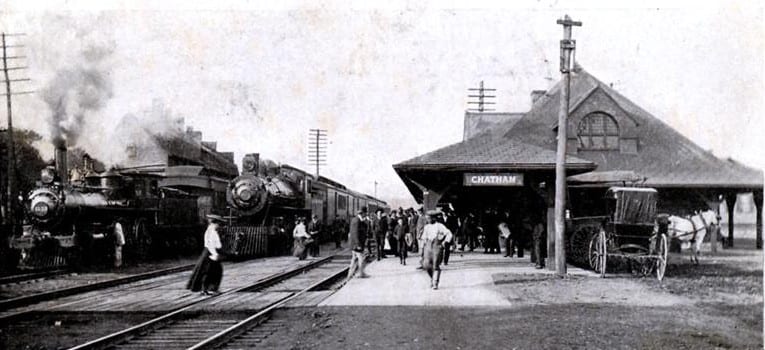
I’m not exactly sure why, but I have a strange affinity for the village of Chatham. Although it is an adorable place, rather quaint, I wonder what exactly it was like when the railroads ran through here. You might see a freight train, or a passing Lake Shore Limited, but none of them stop. Chatham once serviced the New York & Harlem Railroad, the Boston & Albany, and the Rutland – all of which are long gone. And thus the place is a little bit of a curiosity to me. The many suburbs along the Harlem – Bronxville, Hartsdale, Scarsdale, and even the ones further north, Katonah, Brewster – they were all influenced by the rail. They grew and morphed into the places we know now, and though the rail does not entirely define those places now, the rail still is there, playing a part in the futures of those areas. But Chatham, it is a special case. The single most defining factor of the village has disappeared. It is no longer the terminus of any railroads. The once busy Union Station no longer serves train riders, it is a bank. Chatham has reverted to a quieter version of itself, representing a little portion of historical Columbia County.

Many places across the country have seen transformations, with the things they were built upon playing a part in their downfall. Detroit was built on the auto industry, but as the industry migrated and moved overseas, parts of the city have become abandoned – a true example of urban decay. The small town of Centralia, Pennsylvania was built upon anthracite coal, literally and figuratively. Ironically, it was the coal brought the death sentence of the little town, as it caught fire in the 1960′s and has been burning ever since. There is something about these changed places that intrigues me (high on my list of places to visit is also Pripyat, an abandoned town brought down by the failings of humans). All of these, of course, are radical examples. Chatham lives, it does not decay. Perhaps the once-fundamental core of its being is gone, but it still thrives. But just as one can compare the photos of Detroit’s urban decay with the historical photos of yesteryear, one can bear witness to the radical changes made in just a few scant years (or slightly longer than the years I’ve been on this Earth). There are no more signal towers, water towers, or turntables. The children of Chatham will never board a passenger train in their village to head the one hundred and twenty seven miles to Grand Central. And of course, the Harlem division will never again run this far north.

The time for Chatham as a railroad town has passed. As the time has ticked by it has reinvented itself, and is still reinventing itself. It is not the decline as a railroad hub that has intrigued me about Chatham, but that reinvention. It is a charming and beautiful little village, with a gazebo, clock tower, shops, and restaurants – plus a whole lot of history. The photos below were taken back in October upon my second visit to Chatham, a visit where I actually had time to shop and eat, and enjoy the surrounding history. Perhaps if you too find Chatham to be interesting you will take the time to visit some day…


The photos below were sent in by reader John. They were taken in the late 1960′s at Chatham.


For an even further back look, the Library of Congress has an illustrated map view of the village of Chatham from 1886. At this time the “Union Station” had not been built, and the Boston & Albany, and the New York & Harlem each had their own rail stations. For easier viewing I’ve given the B&A station a slight red tint, and the Harlem a blue tint.

Me at Every Harlem Line Station Train Photos

Monday, November 22nd, 2010

Many months ago I began a little project to take a panorama at every Harlem Line station. I am exceptional at beginning projects, yet terrible at completing them. However, this is one project that I will finish. I have now been to, and photographed, every Harlem Line station. After I had decided to actually do this, the first station I photographed was Tenmile River (on May 24th), and the last was Williams Bridge (on November 21st).

Keeping to the schedule of a posting a new station every Tuesday, it will still take another month or so to complete the project publicly. But today I will post the “Hall of Fame” – me in front of the name sign at every station. While I am on the subject of the stations though, I’d like to thank Eric for accompanying me to most stations south of White Plains, my mother, who has now been to every station north of Bedford Hills, and Despina who joined me at Valhalla, Mount Pleasant and Hawthorne.

Sending Postcards from the Harlem Line (Part 1) History Photos

Friday, November 19th, 2010

Hi, my name is Emily, and I have a problem. An addiction, really. And no, I am not referring to my frequent use of hats with ears. I have an addiction to eBay, and buying crazy things there. I’m not quite to the stage where one ought to worry that I am going to end up on that TV show Hoarders. Nor am I to the point where I’ve collected a hundred cats and you can change my nickname from Cat Girl to Cat Lady. But I am somewhat interested in acquiring old things. Like train timetables from 1883, or postcards from the early 1900′s. I began scanning some of the postcards I’ve managed to get… I hope that one day I’ll have one for every station, but I know that is quite a lofty goal. Someday, perhaps…


Tuesday Tour of the Harlem Line: Katonah Train Photos

Tuesday, September 21st, 2010

By now my little photography adventures have taken me to almost all of the Harlem Line stations (the only outstanding stations are Woodlawn, Williams Bridge, Botanical Garden, Melrose and Tremont. I’ve been warned for my safety at the last two). I’ve done a lot of fun things, and gotten to explore quite a bit. I’ve eaten an italian ice in Hartsdale with @kc2hmv, splashed in the river near Crestwood, and munched on good food in Mount Kisco, Valhalla and Tuckahoe. I’ve seen all the Arts for Transit pieces, and other randomly cute things, like the Commuter Rooster in Scarsdale. But despite all this, when I chatted with @bitchcakesny last night and she asked me my favorite station of all, I couldn’t quite answer.

There are so many good things about some of these stations, how could I pick just one? Wassaic and Pleasantville have my favorite Arts for Transit pieces, and I loved Harlem-125th’s art too, not to mention it was a great spot for photography. Bronxville has a unique station, and the shops surrounding Mount Kisco, Hartsdale and Scarsdale are cute and worth exploring. Chappaqua’s restored station building is a beautiful sight, and I’ve always been fond of Brewster’s old station building. What I was able to do though, is narrow it down by asking myself a question: If I had to be stuck at a single station for the entire day (maybe there was a big fire or something, shutting down Metro-North??), which would it be? And that answer is Katonah.

What makes Katonah special? The area around the station is very cute – full of shops and restaurants for eating good food. I will admit though, the Katonah Museum played a part in the decision. If you don’t mind walking the half mile from the station to this art museum, you really could spend the entire day here viewing art, shopping and eating. And if there was still time left you could hang out in the gazebo not far from the station, or go and visit the library which is two blocks away. Katonah is just another one of the nice places located along the Harlem Line, but one that certainly sticks out in my mind.


Nature along the Harlem Line: The Muscoot Reservoir & Bridge L-158 Photos

Friday, September 17th, 2010

I thought it might be fun to do something different this Friday… Tuesdays I visit train stations, but I don’t talk much about what else is around the station. The Harlem Line has plenty of intriguing spots along the route, and many for the nature lover. I do get emails every once and a while asking me questions about doing things – people wondering what is within walking distance of the stations, and what they can get away and do. And for those who, like me, do not drive, or don’t feel like driving, you can definitely take Metro-North to get to interesting spots.

As I mentioned, there are many nature-related locales on the Harlem Line. Some of the obvious ones are the Botanical Garden and the Appalachian Trail, but there are many lesser-known spots. Pawling has the Pawling Nature Reserve, which is not far from the Appalachian Trail. At the end of the line in Wassaic is the trailhead for the Harlem Valley Rail Trail which follows the old route the Harlem Line once took further north. Lower Westchester has the Bronx River Parkway Reservation which is more than 13 miles long and stretches from Valhalla to Bronxville – and passes by North White Plains, White Plains, Hartsdale, Scarsdale, Crestwood and Tuckahoe stations.

One of the lesser-known spots is near and dear to my heart, situated in Goldens Bridge and not far from my house. In the evenings it is here that I make laughable attempts at running off the past nine years I spent sitting on my ass in front of a computer. In all seriousness though, it is beautiful and quiet little spot that few people other than fisherman and neighborhood residents (and some deer, swans and bullfrogs) know about. The trails are not extensive, but they surround the beautiful reservoir and provide access to various fishing spots. I went one step beyond that and purchased a boat for use on the reservoir as well (boat use is heavily regulated, this is NYC’s drinking water, after all). However, the most noteworthy part of this “Public Access” DEP area is the old railroad bridge.


I created this map based on my own explorations of the area. Maps are actually fun to make. :P

I’ve mentioned Bridge L-158 a few times before. It is one of the few remaining vestiges of the branch of the Harlem Line that ran from Goldens Bridge to Lake Mahopac, and is on the National Register of Historic Places. It was originally built in 1883 over Rondout Creek near Kingston, NY, but was moved in 1904 by the New York Central Railroad to Goldens Bridge. Although the original bridge carried two tracks, the Mahopac branch was a single track line and when the bridge was reconstructed the width was shortened for a single track.


If you’re interested in visiting this part of the Harlem Line, it is within walking distance of Goldens Bridge station. Although it is rarely enforced, you do need an access permit to use the land for recreational use. But access permits are easy to get – you can register for one online and print it out immediately. If you’re interested in fishing or boating, you’ll need additional permits, so I advise checking the DEP’s site. People fish in the reservoir all year long, as the Muscoot is one of the reservoirs in which ice fishing is permitted. Although it is a lot smaller than some of the other nature spots around it is at least worth visiting to see the historic bridge. There are some times where it gets so quiet, except for the crunching leaves under the foot of a squirrel or deer, that you forget that you’re not that far from the city… only until you hear a train go by, yanking you back to reality.

Tuesday Tour of the Harlem Line: Bronxville Train Photos Videos

Tuesday, September 7th, 2010

15.3 miles north of Grand Central on the Harlem Line, lies the station of Bronxville – located in the village of Bronxville, and the town of Eastchester. It is one of the more heavily used stations on the line, only Scarsdale and White Plains get more commuters. The railroad has had a presence in Bronxville since 1844, and like many of the suburbs along the line, grew significantly because of it. Bronxville is relatively small – the village is only one square mile, and has a population of around 6,500. It is not only one of the most affluent areas on the Harlem Line and Westchester, it is certainly one of the more affluent areas in the entire country.

Architecturally Bronxville’s station is very different than the tudor-style stations seen at other locations such as Hartsdale and Scarsdale. It was built in Mission Revival style, taking after the Hotel Gramatan, which was built in Bronxville in 1905. Mission Revival is more common in the west and specifically in California – and now that the hotel it was modeled after was torn down in the 1970′s – Bronxville station looks a little bit out of place stylistically. Nonetheless, it is still a beautiful building, and although the inside has seen many changes, the outside is very similar to how it was when completed in 1917. Unfortunately the Saturday I visited the station building was not open, so I never got to see how exactly that inside looked.

The architect for the station was A.F. Haldeman, and not much is known about him. It is possible that he was an architect on the staff of the New York Central and Hudson River Railroad. The only other projects I have seen him referenced in are a freight house in Manhattan, which most likely no longer exists, work on the Port Morris railroad yard, and stairwells for the Harlem station.


For an amusing bit of history, be sure to check out this newsreel video of Bronxville from 1933, Loving husbands face jail for kissing wives:

And here are a couple of views of the station in 1988:

1910 Advertisement, Electric Train Service Now Uncategorized

Sunday, January 30th, 1910

Accessed digitally via the Library of Congress’ Chronicling America.

1908 Newspaper Article, Westchester Outlook & To Electrify Putnam Uncategorized

Thursday, February 6th, 1908