TrainsHistoryObservationsHumorAdvertisementsEventsMuseumsPhotosVideosTuesday ToursPost ArchivesHistorical ArtifactsPanorama ProjectRSS FeedFollow us on twitterSubscribe by emailHome

Archive for December, 2010

Looking back at 2010… a countdown of the most popular Train Humor

Friday, December 31st, 2010

Ah, 2010. You were the first full year that I actually operated this blog. Lots of fun and shenanigans were to be had. I decided to take a look back at what was popular on the site this year, as a wrap-up for 2010…

1. BPGlobal Billboards

The first entry here is not train-related in any way… however it was such a major news story at the time I couldn’t not have some fun with it – though fun is actually a terrible way to describe it, as the Gulf Oil Spill was quite tragic. To me the two standouts in coverage on this was a fake twitter account, BPGlobalPR, and Boston Globe’s The Big Picture. I merged the two into fake billboards, which apparently caught on and made their rounds on the web – and brought around thirty thousand viewers to the site in a single day.

2. Harlem Line Timetables

It is true, I have turned into an eBay whore… collecting just about anything regarding the Harlem Line. Many of the timetables I have can be found on the second most popular part of the site, the Harlem Line Timetables archive. It is desperately needing updating, as I own or have scanned many more timetables than are currently pictured. My goal was always to have a timetable for every year, and for the most part I do have that, from 1930 on up. Look for a major overhaul of this section in 2011!

3. Stupid Warning Signs

Ah, stupid warning signs. One of the most amusing things I’ve made for the site. These popular signs round out the top three most popular things on the site this year. Folks have requested that I turn these into stickers, but if you people start sticking these on trains the MTA PD might actually have a real reason to arrest my ass.

4. The Cutest Train Car in the World

One of the posts I made after returning from Japan featured the Tama Densha railcar of the Wakayama Electric Railway. The railroad is known in offbeat circles around the world due to the fact that they employ a feline Stationmaster (I believe she’s actually been promoted to Vice-President now). Tama the cat was so popular, designer Eiji Mitooka created a train car in her honor. The front of the train has whiskers, the seats inside have cat print. My favorite part of the train? The library full of books for the kids.

5. Centalia, PA – Burning Ghost Town

I’ve always been fascinated with Centralia, ever since I first read about it on the internet many years ago. Since then I’ve visited several times. The story begins in the 1960′s, when a coal seam under the town caught fire. It continues to burn to this day. The land has fissures that belch smoke, and it permanently smells of sulfur. It is a tragic story, as the once bustling small town has been whittled down to less than ten citizens.

The coal under the town that is burning is anthracite – which was popularized in little rhymes about Phoebe Snow in advertisements for the Lackawanna Railroad.

6. The Loneliest Station on the Harlem Line

Although I hadn’t come up with the concept yet, the Harlem Line Panorama project began with Mount Pleasant – which I labeled as the loneliest station on the line. The tiny station in between Hawthorne and Valhalla services the cemeteries in the area, and has very limited service.


The first panorama posted on the site

7. The Harlem Line Panorama Project

If you’re interested in seeing all the panoramas to date, located on a map – this is the place to go. This Google map is the seventh most popular portion of the site, although technically it lies off site and on Google’s servers. However, each placemark contains my favorite panorama from that stop, and a link back to the post on this site.

8. Sadie the Subway Cat

The Transit Museum in Brooklyn has employed a cat or two, mostly in the hopes that they would chase away any subway rats. In this eighth most popular post I recollect my first visit to the Transit Museum and my encounter with Sadie… and my crazy idea to get her a miniature-sized train conductor’s hat. Of course none of that really panned out – and as far as I am aware, Sadie has been quietly retired from the public.

9. The #1 Reason to Ride Metro-North

Back in June I posted these spoof ads for Metro-North and beer. If you are a regular commuter you will notice that in the afternoon, and most especially on Fridays, there are quite a few people drinking beer. The exception to that if you are those people that work at Target in Mount Kisco, you’re drinking it in the morning. But since you can’t drink and drive, and you can certainly drink and ride, Metro-North could always have an amusing new ad campaign.

10. M8 Cars Will Not Debut on the New Haven Line

Ah, April Fools Day… I couldn’t resist making a fake post about the new M8′s. Shattering the dreams of many New Haven Line riders, I posted that the red trains would be repainted blue and running instead on the Harlem Line by the end of the year. I even made up some fake quotes and attributed them to Dan Brucker – which probably doesn’t place me very high on his list of awesome bloggers.

So that is it! The ten most popular things on the blog in 2010. Happy New Year everyone!

Taking the Grand Tour: A Review of Grand Central’s New Audio Tour Train Encounters / Observations History Photos

Thursday, December 30th, 2010

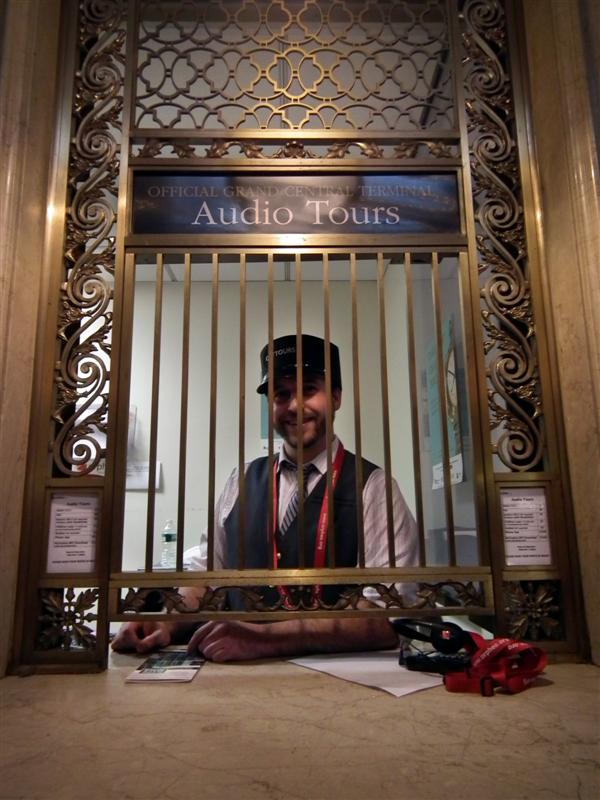
Observant commuters may have noticed something new in Grand Central in November – a little booth by the ticket windows labeled Audio Tours. Or you might have seen it mentioned in the Mileposts, or perhaps in a poster on your train or at your station? Either way there is a new way to tour Grand Central – and I’m not talking about a giant tour group where you have to strain to hear the tour guide. Grand Central now has an official self-guided audio tour. While I was at Grand Central the other day I took the time to give the tour a shot – a review of sorts.

 
Audio tour booth, Metro North employee Patrick mans the booth during my visit

Honestly, I wasn’t expecting much. I know a lot about Grand Central, and I figured that I wouldn’t learn anything new. But I was a tad curious to know what would be included in a tour of Grand Central, and how it would be described. There are a lot of things I know about the history of the place. And I am also aware that there are folks in the hardcore railfan community that are of the opinion that there have been some… shall we say, anecdotal embellishments added into the lore of the Terminal. But there is just so much that can be said about the history of this building, what exactly do you say to fit into an hour, and what parts do you leave out?


Handheld device for the audio tour

I must admit though, I enjoyed the tour. The technology used is great. If you don’t want to borrow the device and headset for the tour you can download it to your own mp3 player – or at least you’re supposed to. I’ve been unable to purchase it on the website, not to mention it lists the prices only in Euros, which irrelevant if the company that made the tour may be foreign, it just looks poor in a US market. The actual devices that you can borrow for the tour are not only audio devices, they have a small screen in which to show a photo of where you currently are on the tour. I love the fact that it really is a self guided tour – you enter the number of the location you currently are in to hear about it. If you don’t want to hear about it, you can always skip that location. Or you can go in whichever order you please. Plus if you want to learn more about something, you can hit the green button. You can customize the whole thing and do whatever you want to.

Plenty of important places are described on the tour – from the obvious 42nd Street façade, to the clock and sky ceiling to the somewhat lesser known whispering gallery, spiral staircase in the information booth, and the walkways in between the glass panels. I loved that there were mentions of the 20th Century Limited, as well as Jackie Kennedy and the fight to save Grand Central. There were also plenty of things that I thought the tour could mention, but didn’t. Since the tour sends you outside anyways to see the façade, why not make another outdoor stop to see the majestic eagle – older than the Terminal itself – which once stood on the original Grand Central Depot? I also don’t recall hearing anything about William Wilgus. Wilgus was the railroad’s chief engineer, and the conceptual mastermind behind Grand Central. The tour briefly mentions that the Terminal ushered in the era of electric trains, but fails to mention why – and this is important! Would the railroad have undertaken such a massive project if steam locomotives were not banned on Manhattan island? Would the massively expensive project have been considered if not for Wilgus’ concept of air rights, of covering over the formerly open-cut railroad tunnels and building on it to recoup expenses and make money?

The tour does fall more on the side of artistic/architectural than railfan. But just the fact that the purpose of the building is for servicing rail, I think more of that rail history ought to be thrown in. What makes Grand Central a great railroad station, and not just a pretty building? (and I am talking more about dual levels and loop tracks, as opposed to ramps, which were mentioned)

 
Eagle originally from Grand Central Depot

For the most part the main narration of the tour was great. It was informal, like you were listening to an actual tour guide as opposed to reading one of the many books on the subject of Grand Cental. There were amusing little anecdotes thrown in, like the person asking the person at the information booth where to rent a horse. A lot of the extra details and stories on the “secrets” were recited by Dan Brucker… and I mean no insult to Dan, but there were times where it was tiresome to listen to his voice. He spoke loud and slow, perhaps as one would speak to a non-english speaker, hoping that over-enunciating words will help them understand. “This. Is. Not. A. STA-TION. It. Is. A. TER-MI-NAL. Be-cause trains. TER-MI-NATE. Here.” Now although I’ve never formally met Dan Brucker, I’ve overheard him doing tours. He is animated and it is obvious that he loves this place. But I don’t think that gets through in the tour. (Sorry Dan, please don’t be insulted, I’d still love for you to give me a tour any day!)

One option on the tour, which I believe was called Visual Experience has not been completed yet. The device mentioned that it is being worked on and will include clips from shows filmed in Grand Central. I hope they’re talking about audio clips and not video clips, because even though the device has the capacity for video the screen is so small. And if I had a hard time seeing what was in the tiny picture, then I am certain the little old ladies that took the tour right before me would have a major difficulty. Something on the other hand that might actually work would be a small companion brochure or booklet that accompanies the tour. Right now you just get a big clunky sheet of laminated paper with a map, which you can’t keep. I’m sure tourists would love something that can actually be kept. If cost is a prohibitive issue I’m sure an extra dollar or two could be charged for the nicer booklet.

Well, this certainly turned out to be the long-winded review. Basically it comes down to this:
Do I recommend the tour? Yes. The tour is ideal for people that enjoy the architecture and might not know a lot about Grand Central. If you know a lot about the place you’re probably not going to get as much out of it, but you’ll still probably enjoy it.
Did I learn anything on the tour? Yes. Somehow I had never even noticed the mural on the ceiling of the Graybar Passage.

Chatham: Revisited Train History Photos

Wednesday, December 29th, 2010

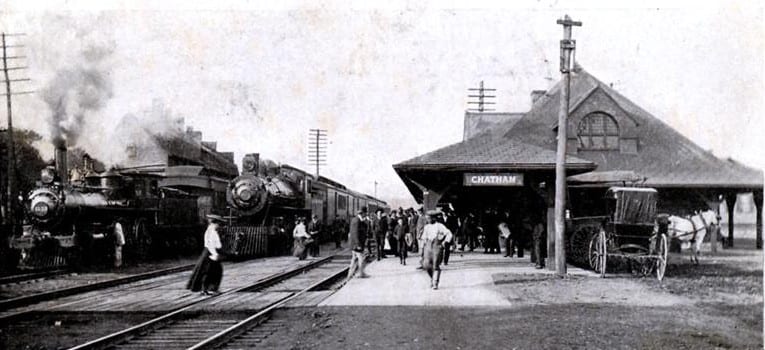
I’m not exactly sure why, but I have a strange affinity for the village of Chatham. Although it is an adorable place, rather quaint, I wonder what exactly it was like when the railroads ran through here. You might see a freight train, or a passing Lake Shore Limited, but none of them stop. Chatham once serviced the New York & Harlem Railroad, the Boston & Albany, and the Rutland – all of which are long gone. And thus the place is a little bit of a curiosity to me. The many suburbs along the Harlem – Bronxville, Hartsdale, Scarsdale, and even the ones further north, Katonah, Brewster – they were all influenced by the rail. They grew and morphed into the places we know now, and though the rail does not entirely define those places now, the rail still is there, playing a part in the futures of those areas. But Chatham, it is a special case. The single most defining factor of the village has disappeared. It is no longer the terminus of any railroads. The once busy Union Station no longer serves train riders, it is a bank. Chatham has reverted to a quieter version of itself, representing a little portion of historical Columbia County.

Many places across the country have seen transformations, with the things they were built upon playing a part in their downfall. Detroit was built on the auto industry, but as the industry migrated and moved overseas, parts of the city have become abandoned – a true example of urban decay. The small town of Centralia, Pennsylvania was built upon anthracite coal, literally and figuratively. Ironically, it was the coal brought the death sentence of the little town, as it caught fire in the 1960′s and has been burning ever since. There is something about these changed places that intrigues me (high on my list of places to visit is also Pripyat, an abandoned town brought down by the failings of humans). All of these, of course, are radical examples. Chatham lives, it does not decay. Perhaps the once-fundamental core of its being is gone, but it still thrives. But just as one can compare the photos of Detroit’s urban decay with the historical photos of yesteryear, one can bear witness to the radical changes made in just a few scant years (or slightly longer than the years I’ve been on this Earth). There are no more signal towers, water towers, or turntables. The children of Chatham will never board a passenger train in their village to head the one hundred and twenty seven miles to Grand Central. And of course, the Harlem division will never again run this far north.

The time for Chatham as a railroad town has passed. As the time has ticked by it has reinvented itself, and is still reinventing itself. It is not the decline as a railroad hub that has intrigued me about Chatham, but that reinvention. It is a charming and beautiful little village, with a gazebo, clock tower, shops, and restaurants – plus a whole lot of history. The photos below were taken back in October upon my second visit to Chatham, a visit where I actually had time to shop and eat, and enjoy the surrounding history. Perhaps if you too find Chatham to be interesting you will take the time to visit some day…


The photos below were sent in by reader John. They were taken in the late 1960′s at Chatham.


For an even further back look, the Library of Congress has an illustrated map view of the village of Chatham from 1886. At this time the “Union Station” had not been built, and the Boston & Albany, and the New York & Harlem each had their own rail stations. For easier viewing I’ve given the B&A station a slight red tint, and the Harlem a blue tint.

Tuesday Tour of the Harlem Line: Crestwood Train Advertisements Photos

Tuesday, December 28th, 2010


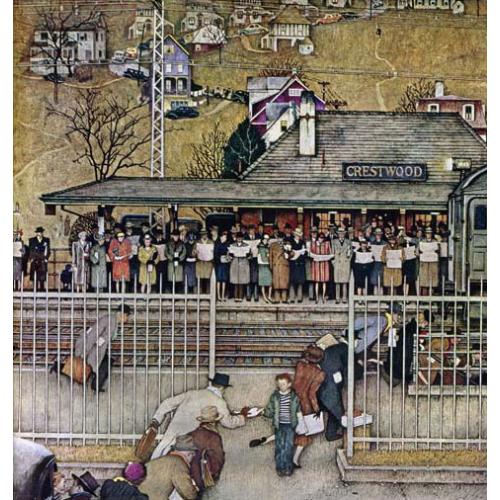
Norman Rockwell’s version of Crestwood

Not many train stations can claim the honor of having been featured on the front of the Saturday Evening Post… or for that matter, having been painted by iconic American painter Norman Rockwell (Rockwell had a long association with doing covers for the Post, stretching from the 1920′s to 1970. He also lived in the area for a time). One such station that can claim that, however, is Crestwood. Crestwood can also claim that it has been featured in video, from television commercials (Tuscan milk, Optimum Online), and even a movie or two (Remember Me, 13). Yes, Twilight lovers, that means that even Robert Pattinson has been to Crestwood.


Optimum commercial filmed at Crestwood

The train station we know now as Crestwood started out under the name of Yonkers Park in the mid 1800′s. Unlike many of the other areas along the Harlem Line, the area surrounding Crestwood was not immediately built as residential. Although the Tuckahoe area, and the discovery of Tuckahoe marble, led the community to grow rapidly, the area around Crestwood was mostly occupied by quarries. It did not develop into a residential area for commuters until the first half of the 1900′s. The growth in population did get the railroad to make Crestwood a regular stop on the Harlem, and an updated station built.

The current station at Crestwood was built at some point between 1901 and 1911, the actual date unknown, as the original plans have been lost. There are, however, records of changes made to the station later on, like when the tunnels under the tracks were built in 1911. In 1928 more significant changes were made, resurfacing the outside, removing the original chimney and installing a new one, and replacing the slate roof with shingles. The original baggage room was also removed in order to enlarge the ticket office.

Crestwood is the last station that I will feature that was part of the Mid-Harlem Station Improvement project. The project consisted of updating eight train stations on the Harlem Line in the late 1980′s. Before the changes were made, each station was documented with a history and photographs, all of which are available online thanks to the Library of Congress. One of the major changes that occurred at Crestwood was the creation of a ticket window above the tracks, and the phasing out of the original station building as a ticket office. As of 1993, nothing had been done with the station, and upon my visit the station building still looked pretty dead. The newer ticket window was also quiet – it was permanently shuttered last year.


Here are a few of the historical shots of Crestwood, taken in 1988, which include a view of the inside of the old station building. All of these are from the Mid-Harlem Station Improvement project page at the Library of Congress.


Happy Holidays from Conductor Dog and IRideTheHarlemLine.com! Train

Saturday, December 25th, 2010

If you didn’t get this year’s holiday card in the mail, here it is! Conductor Dog wishes you a very happy holiday and new year… and would love it if you happen to have any treats. He is eagerly awaiting his debut as Metro North’s mascot, with an appearance in Mileposts. Hey, a dog can dream, right?

Vintage Holiday & Winter New York Central Ads Train Advertisements

Friday, December 24th, 2010

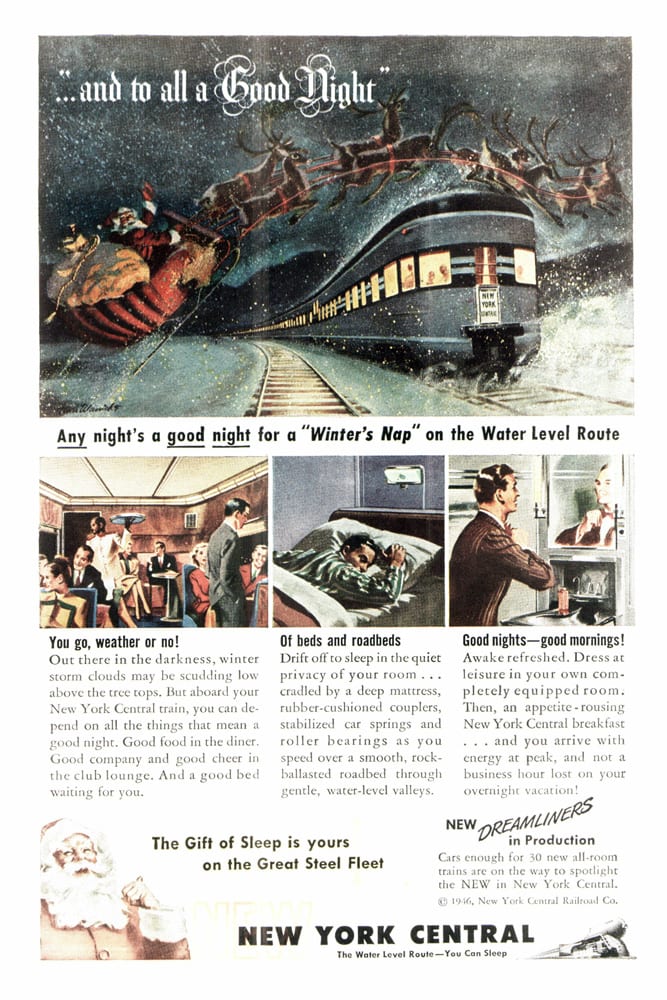
Hopefully all of my readers that celebrate Christmas are enjoying your Christmas Eve… Did I ever mention that I love looking at vintage ads?`Even better are vintage railroad ads. Here is a little collection of holiday and winter ads from the New York Central. Have a great holiday, everybody!


If you liked these ads, check out another set of New York Central vintage ads from World War II that I posted back in June.

Tuesday Tour of the Harlem Line: Tremont Train Photos

Tuesday, December 21st, 2010

The next time you’re riding a train out of Grand Central, give a little wave goodbye when you pass Tremont station, at mile post 7.9. For Tremont is a lonely station – it may have four tracks, and it may see every Harlem and New Haven line train pass by, but only a handful of them stop. Like Melrose, Tremont is a Bronx station with somewhat more limited service than most other Harlem Line stations. During non-rush hours, that means a train about every two hours. Tremont is also small – the platform can accommodate only two train cars.

Enjoy this quick look at Tremont station through various panoramas… This pretty much wraps up our tour to the Harlem Line’s more limited service stations. Melrose and Tremont are like the big brothers of the bunch, as their limited service is much more often than the once or twice per day Mount Pleasant and weekend-only Appalachian Trail. These are the final weeks of my Tour of the Harlem Line, as I’ve featured most of the stations so far. Next week we’ll go and visit Crestwood, the last station to be featured that was part of the Mid-Harlem Station Improvement project (all of which have photos preserved in the archives of the Library of Congress).


Holiday Trains & Old Holiday Timetables Train

Monday, December 20th, 2010

Looking to take the train for the holiday? Metro-North has you covered with pre-Christmas early getaway trains, Christmas eve, and Christmas day service, as well as New Years trains. Check out the Holiday Service page on the Metro-North website, or the Early Getaway Trains schedule on their Facebook page.

And if you’re in a particularly holiday-cheerful mood, check out some railroad holiday/winter brochures and timetables from my collection…


Fall Photos from the Walkway Over the Hudson History Photos

Thursday, December 16th, 2010

Several of my blog readers have been long convincing me that I needed to get over and see the Walkway Over the Hudson. At the end of October I cheated on the Harlem, and hung out over on the Hudson side of things – checking out the former station in LaGrange, Bannerman Castle, Milton-on-Hudson’s historic station (pictures yet to be posted), and the Walkway Over the Hudson. Other than the fact that I was pretty sick that day, the trip was great. The day was beautiful and warm. And considering I felt like crap and had to cough up a few hairballs (the perfect euphemism for me!) after taking these photos, I’m pretty proud that I managed to get some good ones.


Old postcard views of the bridge

Of course the Walkway has only been a walkway for a relatively short amount of time. The majority of its years were spent carrying trains over the Hudson River. The Poughkeepsie-Highland Railroad Bridge, completed in 1888, was a modern wonder – and one of the longest bridges in the world at the time. The bridge served as an important crossing, especially for troops during World War II. It is estimated that 3,500 train cars passed over the bridge every day during that period. After the 60′s the bridge’s importance declined, and it was damaged by fire in the 70′s. By the 90′s Walkway Over the Hudson proposed turning it into a pedestrian bridge, and in 1998 the bridge was deeded to them. Construction began in 2008, and was completed in 2009. The Walkway Over the Hudson State Historical Park was officially opened on October 3, 2009. It is accessible from both sides of the river in Poughkeepsie and Highland. It is also accessible from Metro-North’s Poughkeepsie station. The walkway offers gorgeous views of the Hudson River, the Mid-Hudson Bridge, and Highland and Poughkeepsie. It also connects with the Hudson Valley Rail Trail in Highland. A few of the photos below, such as the one of the caboose, is from that rail trail.


Tuesday Tour of the Harlem Line: Hawthorne Train Photos

Tuesday, December 14th, 2010

Every morning I start out my day taking Metro-North down to White Plains. Now one would probably assume that White Plains is the closest train station to my work, but the fact is that it is not. Mount Pleasant is actually the closest, but as it isn’t a regular stop, the closest train station would be Hawthorne. The place I work for has a shuttle bus that goes to and from White Plains though, so it is easier for me. But there are the occasional times where I end up going to Hawthorne or Valhalla, like when I leave work early and such. So although I am not a regular rider from the station, I am a bit more familiar with it than many of the other stations I’ve visited on the tour. I’ve seen it on the sunny days, and even on the snowy days. I am always curious about the changes going on at the station, such as the coffee shop that is supposed to be arriving at some point in the station building. And I was rather excited when the flowers arrived, along with the new clock in front of the station (which in my photos below had yet to be revealed).


Original Hawthorne station, circa 1900. Note the sign on the front which lists the distance in miles to each end of the railroad, in Chatham on one end and in New York City at the other. A similar sign still exists at Mount Kisco.

When the New York & Harlem Railroad first began making stops here in the 1840′s, the station was named Unionville. If the current name of Hawthorne evokes the memory of an American author, you are certainly on the right track (no pun intended). In 1901 Unionville became Hawthorne, honoring Rose Hawthorne Lathrop, daughter of author Nathaniel Hawthorne. Rose became a nun and was known as Mother Mary Alphonsa, founder of a home for those suffering from incurable cancers.

Below are some of the photos I took in Hawthorne at my last visit (which was sometime around July). The clock had recently arrived, the sky was an amazing shade of blue, and the flowers were blooming. In fact I think one of my favorite photos that day was the one of the flower. Although many of the stations I’ve visited I may never go to again, I’ll be checking up on Hawthorne in the future, as I’m eagerly awaiting the new coffee shop… and I’ll probably have to do a before and after of the little station building.