TrainsHistoryObservationsHumorAdvertisementsEventsMuseumsPhotosVideosTuesday ToursPost ArchivesHistorical ArtifactsPanorama ProjectRSS FeedFollow us on twitterSubscribe by emailHome

Archive for April, 2010

Friday’s From the Historical Archive: Leslie Ragan, Artist of the New York Central Train Advertisements History Photos

Friday, April 30th, 2010

Back in February I spent a good majority of a Saturday hanging out at the Research Library at the Danbury Railway Museum. I was interested in seeing what they had in their collection regarding the Harlem Line, especially timetables. I wasn’t intentionally looking for the entire system-wide timetables published by the New York Central, but when I saw them, I really fell in love. These system timetables were really where Central showed off, with some really gorgeous art. It wasn’t later on after researching that I found out that many of these timetables were based off of art previously commissioned for a poster marketing campaign.

New York Central’s poster campaign began in 1925, after experimenting first with calendars. The marketing campaign was planned along with Central’s centennial celebration. The general theme of the campaign was to display the routes of the rail line: the natural landscapes, as well as the cities. A range of commercial artists were commissioned to design posters, one of which was Leslie Ragan. Ragan’s first New York Central poster, a Chicago cityscape, was published in 1930.

Ragan was born in 1897 and grew up in Iowa. From an early age he knew he wanted to be an artist, and often made drawings of buildings and bridges. Ragan was mostly self-taught, although he did attend the Cumming School of Art in Des Moines. He served in the Air Force in World War One, and upon returning studied for a single semester at the Art Institute of Chicago. In the early 1920′s, he went on to teach at the Academy of Fine Arts, also in Chicago. By 1930 he had relocated to New York and had begun painting for the New York Central.

I’ve gathered quite a collection of examples of Ragan’s art for the New York Central. I must admit that I love the way he painted clouds – whether they were clouds in the sky, or steam from a locomotive. His depictions of trains were very streamlined and smooth, accentuating the shape of the upper portion in which a person rides, and hiding the moving parts below. His art certainly has influenced some people today… if you’ve seen the movie poster for The Polar Express, you will note it bears quite a resemblance to the winter poster at the very bottom.


(more…)

WTFopoly: New York City Subway Edition Monopoly Game Humor

Thursday, April 29th, 2010

I am so eagerly waiting for my WTF subway shirt. But it hasn’t arrived yet. So in order to console myself, (and in my boredom) I created some more amusing subway WTF-ness. Now not only can Metro-North hate me, but NYC Transit (I still love you, I swear!) can hate me too! And maybe even Parker Brothers, who publish the game.


Instead of Community Chest (what the hell is that anyways?), I opted to replace it with the “Service Change.” For pieces, I figured it might be amusing to throw in a delightful subway rat, and even a pigeon in there. If you bought the “extended version” of the game, there would even be a special “limited edition” Sadie the Subway Cat piece. Gotta market that stuff! And everybody loves cats!

As for the properties in the game, and how I determined where each of them belong, I used the 2009 Subway Ridership Facts & Figures. Blue, green, and yellow properties (the highest value) are the top subway stations, system wide. Red represents Manhattan, Orange is Brooklyn, Magenta is Queens, Light Blue is the Bronx, and the top subway stations for each (not counting any stations previously used). The Purple spots are the bottom two stations in the subway system by use. Instead of the four railroads typically used in Monopoly, there are the other MTA entities: Metro-North, Long Island Rail Road, Long Island Bus, and the other half of NYC Transit, the bus system. There are no “utilities” but instead MTA Bridges, and MTA Tunnels.

Oh, and in order for you to get thrown in jail, you are caught with a copy of the master key.

A Visit to Shibuya Station: Hachiko the Loyal Dog & a Cat Cafe Train Photos

Monday, April 26th, 2010

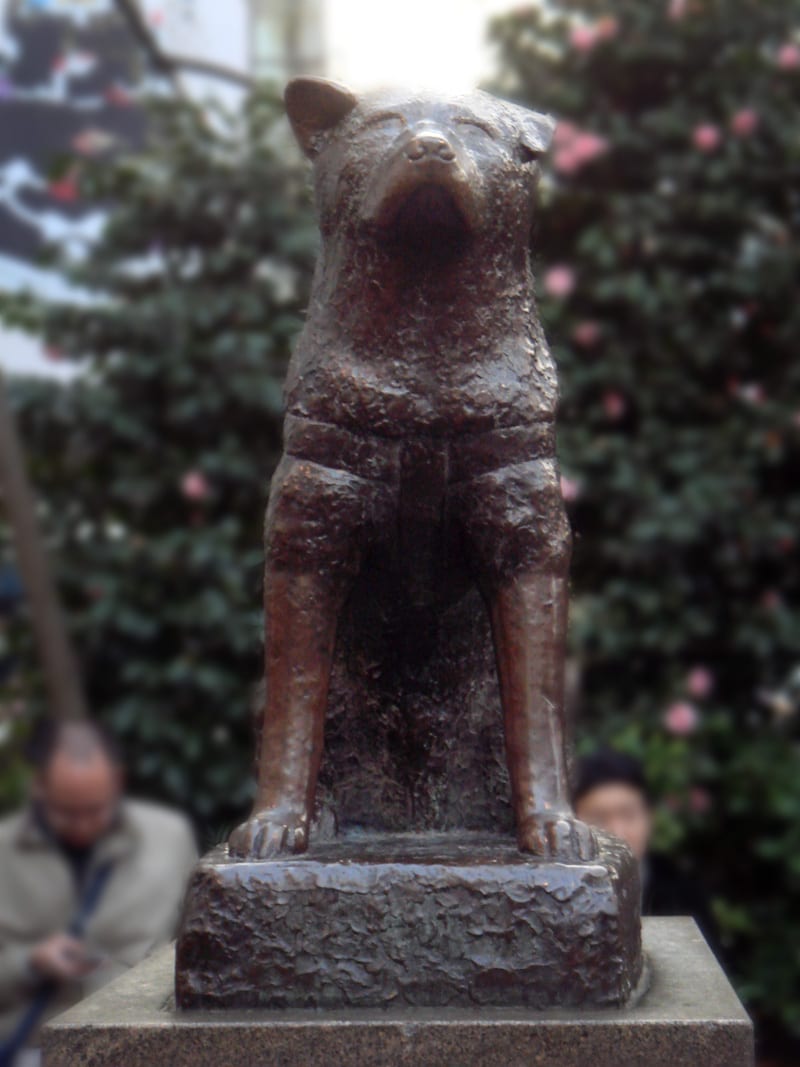
Tokyo’s Shibuya Station is the fourth busiest commuter rail station in Japan, though it’s claim to fame is in canine form. Across the world many are familiar with the story of the loyal dog, Hachiko, who was a fixture at the station in the 1920′s. Hidesaburo Ueno, a Professor in Agriculture at Tokyo Imperial University used Shibuya Station to commute to work. His young Akita dog, Hachiko, would wait for him at the station every evening after work. In May of 1925 Ueno collapsed while giving a lecture, and died from a cerebral hemorrhage. Despite the fact that his master was gone, and would never return, Hachiko still waited at Shibuya Station every evening. For nine years, until his death, Hachiko waited at the station. Hachiko’s story became popular when a former student of Ueno’s wrote an article about his loyalty, which was published in a Tokyo newspaper.

A year before Hachiko’s death a bronze statue was erected outside Shibuya Station. Unfortunately, During World War Two, the statue was melted down for the war effort. In 1948 a new statue was designed by the son of the original artist, and is on display outside the station. The statue serves as a popular meeting point, and isn’t too hard to find. Just look for the signs in the station that point to the “Hachiko Exit.”

Several movies have told the story of Hachiko, the first being Hachiko Monogatari, in Japanese. This movie was remade in English and titled Hachiko: A Dog’s Story, and starred Richard Gere as Parker Wilson. To make the more palatable for a Western audience, all the Japanese people were removed, and the story was set in Rhode Island. The writers couldn’t seem to figure out how to explain why a white guy would name his dog Hachi (-ko was a suffix added to the name Hachi, which also was not explained by the movie), so they had to include one Japanese character: the stereotypically mystical, wise Japanese colleague of Parker’s. What a rather harsh critique from me. But I won’t lie. The movie made me cry. Shit, I was crying when it started, as Parker played with Hachiko as a puppy. I kept thinking, “You’re both going to diieeee at the end!”


The poor lighting made a good shot hard. About ten minutes afterward it began raining. You can find better photos on Google. So I figured I might as well try to be unique and show you it in Stereographic 3D!

Not far from the Hachiko Exit of Shibuya Station is a place called HapiNeko. Prior to going to Japan I had heard of a Cat Cafe, and thought it would be fun to visit one. We totally ran into HapiNeko by accident though, outside of the building there was a large sign with a picture of a cat. I can’t read Japanese, so I wasn’t a hundred percent sure what exactly the place was, but we ventured up to the third floor of the building. Thankfully in the suite we found cats, as opposed to creepy old men attempting to entice young schoolgirls so they could steal their panties for used panty vending machines.

In a country where space is an expensive commodity, not everyone has room for a pet, or is allowed to keep one in their apartment. Cat Cafes have opened up across Japan, charging a small fee for patrons to spend time with a cat and relax. The concept is not reserved to cats alone, at the Tokyo Dome Amusement Park, an impromptu animal area was set up with temporary fences. People could pay 500 yen (around $5) to spend time with various animals: dogs, cats, chicks, a goat, and even a rather large tortoise. I love cats just as much as Japan does, so I could not resist entering the cafe, paying around ten dollars for half an hour with the cats, and a cup of apple tea.

Like most Japanese homes, one is required to remove their shoes before entering. The clerk reads you the rules, and explains how to properly hold the cats without hurting them. Once inside there is a sink in which you are required to wash your hands, and then use alcohol. Any bags or luggage you may have is taken and put into a cubby. You place your order for a drink, and then you are permitted to enter the room with the cats.

HapiNeko employs a staff of sixteen cats, most of which are around three years old. Breeds include American shorthairs, a British shorthair, a Russian Blue, Scottish Folds, Bermans, and a Persian. Their names range from typical Japanese: Ryoma and Hinako, to more American: Gigi, Lara, Mimi, Princess, Nina, Marcia and Mocha, to slightly more amusing: Milk, Tofu, and Roll.


As my friend and I left the Cat Cafe and made our way back to the station, it had begun to rain. The massive throngs of people in the world-famous scramble crossing had disappeared. A few braved the pouring rain with their umbrellas, but walking by Hachiko, the massive crowd still remained.

Photos & Bar Car News: NY Times Reporter “Ignored the facts in favor of a sexier story” Train Photos

Friday, April 23rd, 2010

The other day the New York Times had an article about the supposed demise of the Bar Car on the New Haven Line. It has been widely reported in the blogosphere, even on Gothamist and the Huffington Post. Interestingly, Jim Cameron, the Connecticut Rail Commuter Council Chairman, sent out an email alert saying it isn’t so. In fact he goes so far as to say that the New York Times’ reporter “ignored the facts in favor of a sexier story” when writing the original story. Below is the transcript of the email:

Fellow commuters…
“Never let the facts get in the way of a good story”.
This old newsroom mantra apparently was the rule when the NY Times yesterday ignored the facts and presented the headline… One for the Road? Bar Cars May Face a Last Call

Though three members of the CT Rail Commuter Council worked with reporter Michael Grynbaum to get the story right, he ignored the facts in favor of a sexier story. The reporter implied that when the new M8 cars arrive, the 8 existing bar cars would be replaced. Not so! The 8 bar cars we have all have undergone recent rehab’s and can run for 10 – 15 more years. He also implied that “the recession” might force a rethinking of plans to order new bar cars.

The Commuter Council, meeting last night, was reassured by both Metro-North and CT DOT that there are no plans to eliminate bar cars on Connecticut trains. CDOT also told the Council they would share design concepts with us for new M8 bar cars, currently under bid from Kawasaki. The issue of continued if not improved bar car service has been a priority of the Commuter Council for the 25 years of its existence. We will continue that advocacy… and seek a correction from the NY Times for its sloppy reporting.

“Cheers”!

Jim Cameron, Chairman
CT Metro-North Rail Commuter Council

Some time ago my friend Despina took a ride in the Bar Car and sent me some photos she said I should post. I figured now would be a good time to do so. Unfortunately, she rode in the Bar Car in the morning, so it wasn’t open. This led to a discussion as to whether we thought people would purchase things from the Bar Car in the morning, if it were open. And we weren’t directly referring to alcohol, though I am sure a few people out there would certainly consume it on the way to work. They could serve coffee and croissants and other breakfast type things.


Riding in the Bar Car is on my list of things to do before I die. But since the Bar Car will still be around for a while longer, I guess I don’t have to worry too much.

Friday’s From the Historical Archive: Friday’s Harlem Line History Preview: Quick Facts Train History

Friday, April 23rd, 2010

Here’s a confession: I have difficulty in my perception of the passage of time. Always in History class things felt like they were so far distant. And then when I think about it more, I say to myself, “but there are people still living today that went through those events…” so it isn’t possible that they happened as long ago as my mind thinks. When going through all the stuff I put in the Historical Archive, I decided that I wanted to make a timeline. Timelines are really good, but they generally are limited in scope. They usually deal with a particular subject. I could have easily made a “Harlem Line Timeline.” Would it have made total sense to me though? Probably not. I needed something that sort of puts these events in perspective with other things going on at the time. Knowing Cornelius Vanderbilt was born in 1794 is all dandy. But a timeline gives me more an idea of what is going on when it tells me that the man who had the original Grand Central built was alive when George Washington was alive. Washington is like this massive, legendary figure, that for some reason I imagine lived forever and a day ago. So pretty much, I thought it would be cool to do a comparison timeline, the Harlem Line, and US History. Considering that the Harlem Line was started as a part of one of the older railroads in the country, it sort of makes sense.

And if I was absolutely awesome, I would have that timeline for you right now. But because I’m not quite that awesome, I don’t have it completed. If this was in fact History class I would use this excuse… I don’t frequently talk about my roommates on the blog, but if you think I run into crazy people on the train, you should hear some of the stories of what goes on at my house. Last night I had a headache and my roommates were making a lot of noise. You see, they play in a band. This band practices in the basement. I don’t know what the name of the band is, but at one point in time they have referred to themselves as Vaginal Discharge. I kid you not. To my friends, the lead singer is known as “Stripper Girl,” due to the fact that she once worked at Flashdancers. You know, that Gentleman’s Club that frequently advertises on taxis in the city? Yeah. So with all that noise, I had some difficulties in concentrating, and I figured that my lovely readers would understand.

I figured that I’d give a little preview of what I’m working on though. I promise I’ll finish it soon, along with the historical map I’ve also been working on. Please harass me. I am awesome at starting projects, but terrible at finishing them.


Early history. It will be cooler when finished.


Only 24 states when the New York & Harlem Rail Road was chartered. “That’s like, less than half!” says my roommate. And no, I don’t have pictures of her.

The Loneliest Station on the Harlem Line Train Photos

Wednesday, April 21st, 2010

Nestled in between the stations of Valhalla and Hawthorne on the Harlem Line is an active station that you might not be aware of. Most trains pass by without stopping. On weekdays, only one train in each direction makes a stop there. On weekends there are three. The station is Mount Pleasant, and it just might be the loneliest station on the Harlem Line. The only other station that could arguably take the title is Appalachian Trail, which is north of Pawling and in diesel territory. That station does not get any trains on weekdays. But then again, when at Appalachian Trail, at least you aren’t surrounded by thousands of dead people. Mount Pleasant does not serve commuters, it serves those who wish to visit their loved ones in the various area cemeteries. Last week I got a chance on a lunch break to go down to Mount Pleasant station and snap a few pictures. I didn’t want you guys to think that I forgot all about the Harlem Line as I am posting all my wonderful Japanese adventure photos. Nope, I haven’t forgotten!

Panorama of the South-side Platform

You may not have noticed the station, but you probably have noticed the cemetery. Kensico, Sharon Gardens, Gate of Heaven, to name a few. Though passing through on the train, they blend into one large whole. And it is one of those delightful areas in which cell phone reception just seems to disappear. In addition to serving loved ones, the tiny one door platform also serves folks wishing to view the graves of quite a few famous people. I’ve previously mentioned that at Kensico Cemetery, Randroids can pay homage to their Objectivist leader Ayn Rand. Visitors to Heaven’s Gate can visit the resting place of Babe Ruth, which prior to 2004 had many visitors praying for the reversal of a particular curse…


The first pictures are of the south bound platform. The last two pictures above are the platform on the north bound side. Not only can you see various graves behind the station, but there are unused grave markers sitting right next to the platform! The two platforms are not exactly across from one another, they are set apart by thirty-or-so feet. But this is it, this is Mount Pleasant. There are no shelters, no ticket machines. Most of the signage still bears the old circular-M logo of the MTA, and the old Metro North Commuter Railroad name. One side of the sign, however, has the newer logo and the abbreviated name of Mt. Pleasant. There may be plenty of cars passing by, but it is still pretty lonely. And I don’t really think I’d like to be here if it were dark… too many dead people.

The Coolest (or at least the Cutest) Train Car in the World: Wakayama Electric Railway’s Tama Densha Cat Train Train Photos Videos

Monday, April 19th, 2010

One of my more crazy missions when I was in Japan was to see the feline Station Master Cat, Tama. Everybody pretty much loves Tama. When Wakayama Electric Railway was on the verge of bankruptcy, Station Master positions were eliminated, and the stations left unmanned. The decision to make a stray calico cat the honorary Station Master may have been the best decision the company ever made. Tama gained quite a following of fans. Many folks began taking the train: to see her! A study by Osaka University was conducted, which found that Tama brought at least one billion Japanese Yen into the local economy… or around 10.8 million US Dollars. The Wakayama Electric Railway is now thriving, and in her honor a special train car was designed. It is called the Tama Densha. Densha is a Japanese word for train.


The Tama Densha operates on Wakayama Electric Railway’s Kishigawa Line, running from Wakayama Station to Kishi Station over a track of 8.89 miles. It is a narrow gauge railway, powered by overhead catenary. The train car was designed by Eiji Mitooka (picture at left), an Industrial Designer and Illustrator from Okayama, Japan. He has designed many trains in Japan, including the 800 Series Shinkansen. Mitooka is the Design Advisor for Japan Rail (JR) in Kyushu. The train car is a 2270 Series EMU, originally in service on the Nankai Electric Railway, which underwent an overhaul, interior redesign and exterior repaint in 2009. The cost of the whole redesign cost about 35 million yen, or around 380 thousand US dollars.


Concept sketches for the Tama Densha, by Eiji Mitooka

In order to lure tourists, many local railways have resorted to decorating train cars. When designing cars Mitooka especially considers children, and whether they would enjoy seeing and riding the train. As a child himself, he always drew the trains the passed by his home, and dreamed of being a train designer. Considering the number of trains he’s designed, it seems Mitooka has achieved that dream, and has become quite famous at it. While waiting for the train to Kishi, I rode on one of the normal undecorated trains (in addition to the Tama Densha, there is also the Omoden, or Toy Train, as well as a Strawberry-themed train, all were designed by Mitooka). Several children were in front of me in line to buy tickets, and we left them behind on the platform as the train departed. They wanted to ride the Tama Densha, and waited for the next train. I suppose that is evidence that Mitooka has also succeeded in the part of getting children to enjoy trains. Most children tend not to be patient… yet here they were, waiting to ride a special train!

When riding the Tama Densha on the way back to Wakayama, I figured out why the children wanted to ride it so much. The absolutely gorgeous train is completed with a library full of children’s books and manga. The whole train is truly unique, seats take the form of benches, cat backed chairs, and plush sofas. Cat and calico patterns cover the seats, walls, and curtains. The sideways seat arrangement, with various rings in which extra passengers can hold on, is subway-style and typical of Japanese trains that run short distances. Most surfaces, from the grasp rings to the floor, is made of wood. Not only does it look classy, it creates a warm and welcoming environment for passengers. For the youngest passengers, the also train includes a circular playpen, next to the cage that was created for Tama when she rides.

A short video tour of the Tama Densha can be viewed below. Note that most of the footage was taken at Kishi Station, which is undergoing construction. So if you hear construction equipment in the background, that would be why.

Anyways, that tour was an absolute joy to ride. I was a bit bummed that Tama pretty much slept the whole time I was there, but riding this train certainly made up for it. If I didn’t have places to be, I certainly would have rode that train back and forth up the Kishigawa Line. I just wish we had something like this back in the states!!

Sources for information about Mitooka: 1, 2, 3, 4, 5, 6, 7

Cool Decorated Trains in Japan Train Photos

Sunday, April 18th, 2010

There were a lot of cool trains that I got to ride in Japan. Some were amazingly fast, others had decorated outsides. I put together a little gallery of some of the cooler trains that I enjoyed riding, or seeing on the platform. Enjoy the photos!


Train ID:
Thomas the Tank Engine Train: Keihan Railways (I think), Kyoto, Japan
World of Peter Rabbit Train: Japan Railways, Osaka, Japan
Flowered Train: Nankai Railways, Wakayama Prefecture, Japan
Universal Studios Train: Japan Railways, Osaka, Japan
Purple Nature Motif Train: Japan Railways, Wakayama Prefecture, Japan

Although these may be pretty on the outside, they were nothing in comparison to one particular train that I saw in Japan. I am fairly certain that particular train is the coolest, or at least the cutest, in the world. I’ll have a photo gallery and video tour of that train later on this week. Here’s a little sneak peek:

Passengers: I love to see your feet, & You Parked Like a Jackass Train Encounters / Observations Photos

Saturday, April 17th, 2010

Dear all passengers: I love seeing your feet. I couldn’t even work on my Japanese adventure photos, I had to stop and take pictures of your feet, so everyone can see how wonderful they are! The woman on my train last night really took the cake. Feet way up in the air on the back of the train seat all the way up to Mount Kisco. Not long after I snapped the photo, she took her feet down and put her boots back on in order to leave the train. When she stood up, she just looked like the picture in my mind of a stereotypical Westchester woman. She appears all prissy… she’s the kind of woman that would easily spend two hundred and fifty dollars on boots without a second thought. Except when on the train, those boots just won’t do. They need to come off!

The following lady didn’t really show me her feet. But she fuckin’ loves Metro-North, so she wore her happy socks, and put them up on the seat so everyone can see:

The following picture is old, and I’ve posted it before. But when I think about showing your bare feet on the train, this is what I think in my mind:

In other news, quite a while ago I found this blog called You Parked Like a Jackass. There is a high likelihood that at some point in your life you’ve seen someone park like a jackass. Horribly crooked, taking up two spots, or three, or (the horror!) four! People submit photos of horribly parked cars in lots, and you can even print out “Jackass cards” to leave on the windshield of those cars.

Many mornings in Goldens Bridge I see a van that really parks like a jackass. Well, I can’t really say that they park. Whoever is driving goes to the station, assumedly to wait for someone getting off the train. Instead of waiting in line at the entrance like most cars, the driver attempts to park. Horribly. If you are not handicapped, you are a real asshole to park in a handicapped spot. But a true asshole takes up multiple handicapped spots. What if there really was a handicapped person that needed the spot? Most days there are several other spots available when this person is around. But still, I just have to wonder why someone feels it necessary to diagonally park over two handicapped spots and a place you aren’t supposed to park. Mind you this is not an isolated incident. Note the snow in the picture on the left. This happens all the time.

Just add that to the list of people that probably abuse handicapped spots at the station. Kinda like the guy that is late for the train, parks in the closest handicapped spot, and runs like hell to catch that train that is pulling into the station.

Friday’s From the Historical Archive: 1800′s Animated Stereoviews of Old Grand Central Depot History Photos

Friday, April 16th, 2010

When it comes to 3D, most people are familiar with the type that requires you to wear a pair of glasses and things are tinted in reds and blues. This type of 3D is called Anaglyph. An alternate means of viewing 3D are stereographs, where two slightly different photographs were printed on a card side by side. You were meant to look at the two images and cross your eyes, and supposedly you could see the image in 3D.


An example of a stereographic card

I say “supposedly” because I can’t see these 3D things, so really I am not sure. All these new movies coming out in 3D? Yeah, I’m deprived. I am an amblyope, and am essentially blind in my left eye. I can see small bits of color in large blurs, but not very much. Since you need two good, working eyes to see most types of 3D, I’m out of luck.

Historically, stereographic cards seemed to be pretty popular. The New York Public Library has a collection of quite a few of them, and many were taken of the old Grand Central Depot in the 1800′s. However, in order to simulate the 3D illusion, you can quickly animate the left and right sides of a stereograph together. So I figured I’d try it out with a bunch of the old railroad stereographs I had found. And on some it works pretty well. The technique seems to work best when there is something somewhat close in the foreground of the photo, which you can focus on. That is why the indoor images look better than the exterior images, where everything is rather far away and there isn’t a lot of depth. If you focus on the part of the image that doesn’t move much, you should be able to see it better. If it doesn’t work for you… well, I guess you get to see some jumpy old photos of a long-demolished train station of New York City. Click on each image to see the effect.

Quick Info: Grand Central Depot was built in 1871. It was replaced in 1913 by Grand Central Terminal, which is what we’re familiar with today.
Animated Stereoview Page in the Historical Archives